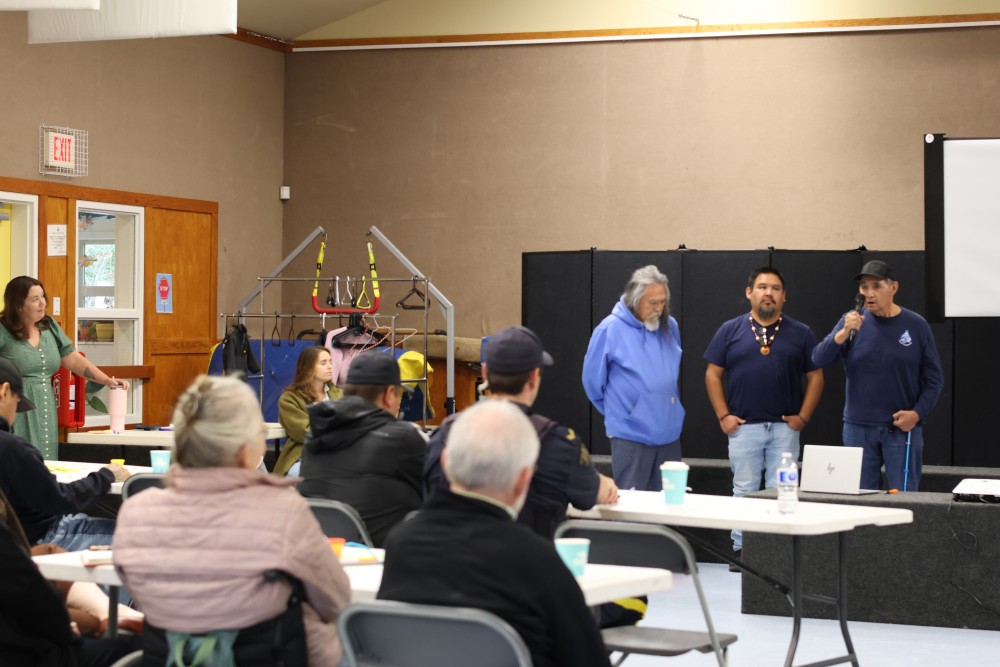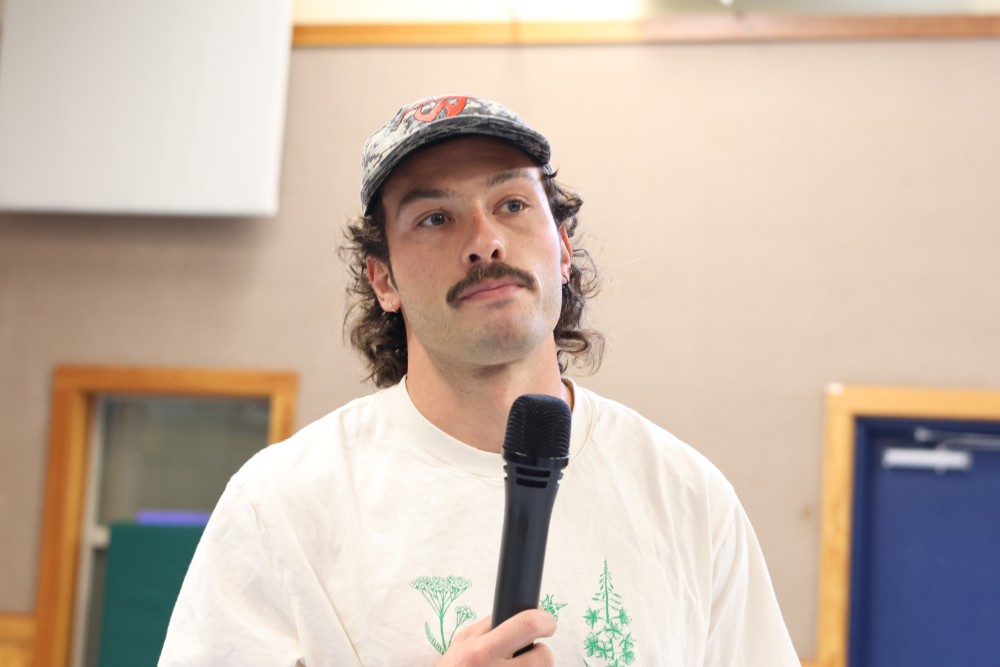
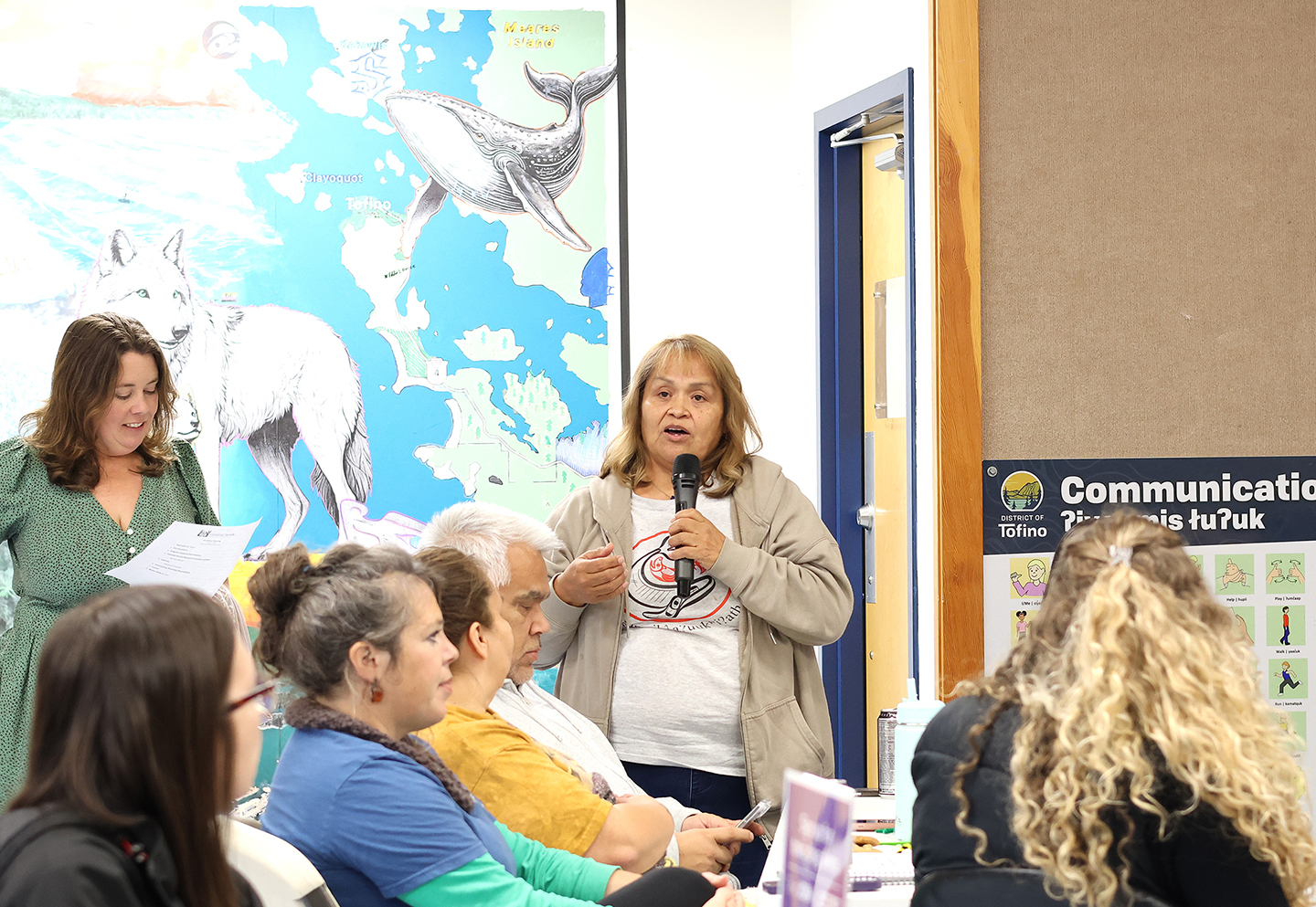
Coastal Family Resource Coalition hosted a Mental Health and Substance Use (MHSU) Summit on Nov. 4 at the Tofino Community Hall.
Key objectives of the of the MHSU Summit was to strengthen referral pathways, improve collaboration among service providers and support greater integration of MHSU services across the region, according to Brooke Wood, event organizer and lead coordinator for the Coastal Family Resource Coalition.
Over 70 regional service providers and community partners attended the half-day networking event, including members from the Ahousaht First Nation village of Maaqtusiis on Flores Island.
On a calm day, it takes about 30 to 40 minutes to reach Maaqtusiis by boat from Tofino’s First Street Dock. During the summit, the weather turned for the worse and the team from Ahousaht made the call to leave the summit early to beat the forecasted strong winds, highlighting the village’s transportation challenges during emergencies.
Dr. Carrie Marshall, Tofino General Hospital’s chief of staff, gave opening remarks.
“There are a lot of incredible things that are happening. There is a lot of foundational work that has gone on over the years, and it can feel like nothing is happening and then something kind of breaks or shifts and then it feels like everything is happening all at once. I think actually we are on the cusp of that,” said Dr. Marshall.
Construction on a Sobering and Assessment Centre for Vancouver Island’s west coast region is underway. The project was first proposed in 2019, according to Wood.
Located in Tofino, the six-bed facility will take pressure off the Tofino General Hospital, which sees alcohol-caused admissions at a rate that is four times higher than the rest of Island Health alcohol hospitalizations, according to 2023 statistics from the Discharge Abstract Database.
The new Sobering and Assessment Centre will offer shelter and assessment for inebriated clients for up to 24 hours and it will also have two dedicated stabilization beds for clients to stay up to 30 days, said Wood.
Dr. Randal Mason, regional medical director for addiction medicine and substance use at Island Health, said MHSU staff will be working out of Tofino’s new sobering and assessment centre. Opportunities for clients to connect to other services will be embedded in the space as well.
“It’s a non-medical space. You won’t have doctors or nurses in there, but you do have care support. It’s really a space for people who are substance affected, assuming that they don’t have other medical needs,” said Dr. Mason.
He also announced at the summit that Island Health opened its first public treatment centre in the region on Nov. 2. The 19-bed facility is located in Parksville.
“(It is) available to all individuals that live within the Island Health services areas,” said Parksville Treatment Centre manager Elizabeth Driver in an email.
“We have prioritization for underserved populations, remote communities and for people from within Indigenous communities,” said Driver.
Tla-o-qui-aht First Nation’s Saasin House has been helping with substance use recovery in the region since 2022. Saasin House is located in the Tla-o-qui-aht community of Ty-Histanis with 16 dedicated beds for Tla-o-qui-aht members and two beds for non-Tla-o-qui-aht.
Roberta Tom, Tla-o-qui-aht’s community services program coordinator, says Saasin House is a “place of safety, respect and learning about each other”.
Rayone Little, Saasin House community wellness and transitional housing units coordinator, re-iterated that Saasin is a safe place to stay.
“We help residents work towards recovery and through the different stages of recovery,” she said.
They shared that the community had two suicide attempts in four weeks.
“It’s so important that we all connect and share what we are doing. I’m really glad to see this room so full of beautiful people who can help,” said Tom.
Hugo LeFrancois, coordinator with the Nuu-chah-nulth Youth Warrior Family, said the Warriors take an upstream approach to substance use by taking youth out on the land and harvesting. He offered up their services to anyone in need.
Dave Frank from the Uut Uuštukyuu Society spoke at the summit. Uut Uuštukyuu Society’s network of healers facilitate access to Indigenous medicine in both reserve and urban communities across Vancouver Island and the Lower Mainland.
“We are not here to take over. We are here to shake hands with your medicines and our medicines,” said Frank.
“We work with the body, we work with the mind, we work with the emotions and mostly we work spirit and soul. When you heal the spirit, the body responds and heals also. We understand also where we are from and we’ve suffered a lot of trauma and our people suffered because of that,” he said.
Curtis Dick, Ahousaht’s manager of security and emergency, attended the summit.
“I deal with people first-hand and we’re the ones that have to take initial impact. Get to know your community and get to know the people who are doers in your community. Leadership is good in some areas, but they don’t see what happens on weekends or after five,” he shared.
In November 2024, Tofino’s government-owned liquor store placed purchase limits on liquor in effort to curtail the flow of hard liquor to Ahousaht. Customers at the BC Liquor store in Tofino can only buy up to four bottles of hard liquor at a time if the alcohol is sold in plastic containers.
But Dick says the purchase limits “haven’t made a dent” and that the bootleggers just find other avenues to bring it in.
“Take vodka off the shelves all together. They do it with American booze, why not do it with vodka here in Tofino. Vodka is the number one killer in our community. I just hope this team comes together and helps out more isolated communities. In time, we will see,” said Dick.
The District of Tofino and Island Health are in the process of creating a Community Alcohol Strategy to help identify community values, align partners and lay the foundation for future policy discussions. Community feedback is currently being gathered, and findings will be presented to council early in 2027, according to Alberni-Clayoquot community health promoter Faye Missar.
For information about regional services and resources, visit: www.coastalcoalition.ca/.