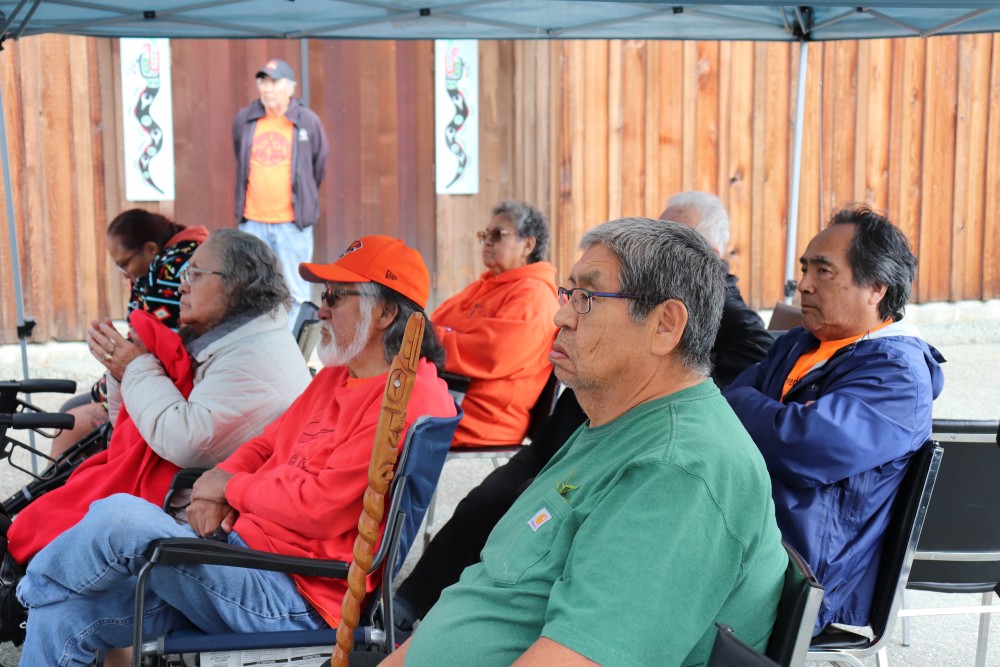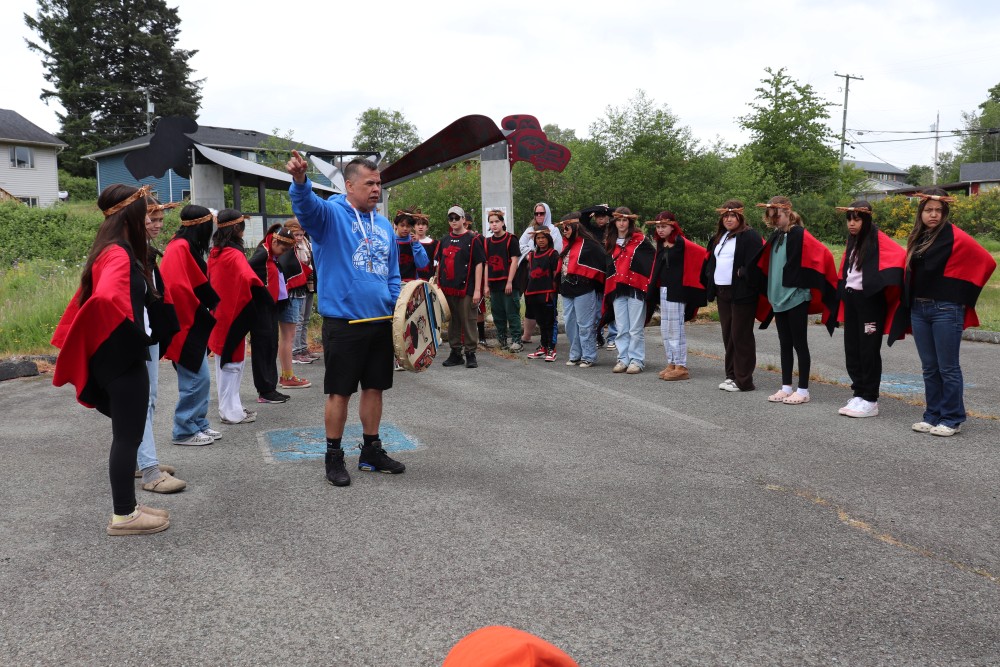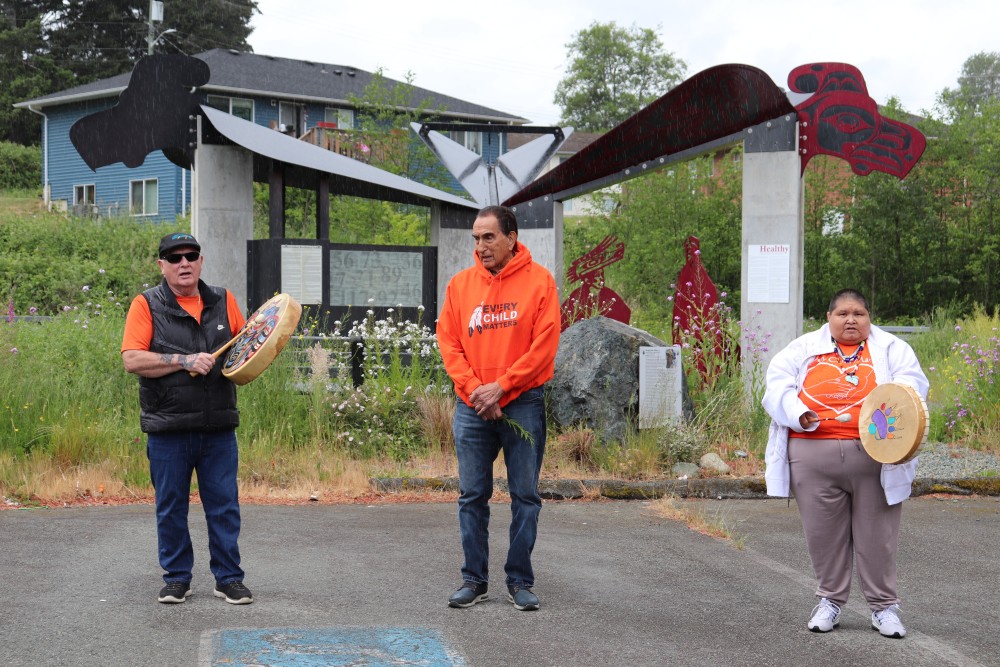
A cleansing light rain fell as survivors of the Alberni Indian Residential School gathered for a somber ceremony at the memorial sculpture near Maht Mahs. They were there at the invitation of Tseshaht First Nation to remember those that didn’t make it home from residential school.
The ceremony was centered around the 5th anniversary of the Tk̓emlúps te Secwepemc (Kamloops Indian Band) announcement of the discovery of 215 unmarked burials on the grounds of the former Kamloops Indian Residential School.
“On this day (May 25, 2026) we will join the 18 IRS (Indian Residential Schools) and three IH (Indian Hospitals) sites across B.C., serving as spiritual doorways to honour the spirits of the missing children that never returned home and to connect our ancestors and Nations,” stated the Tseshaht AIRS Memorial invitation poster.
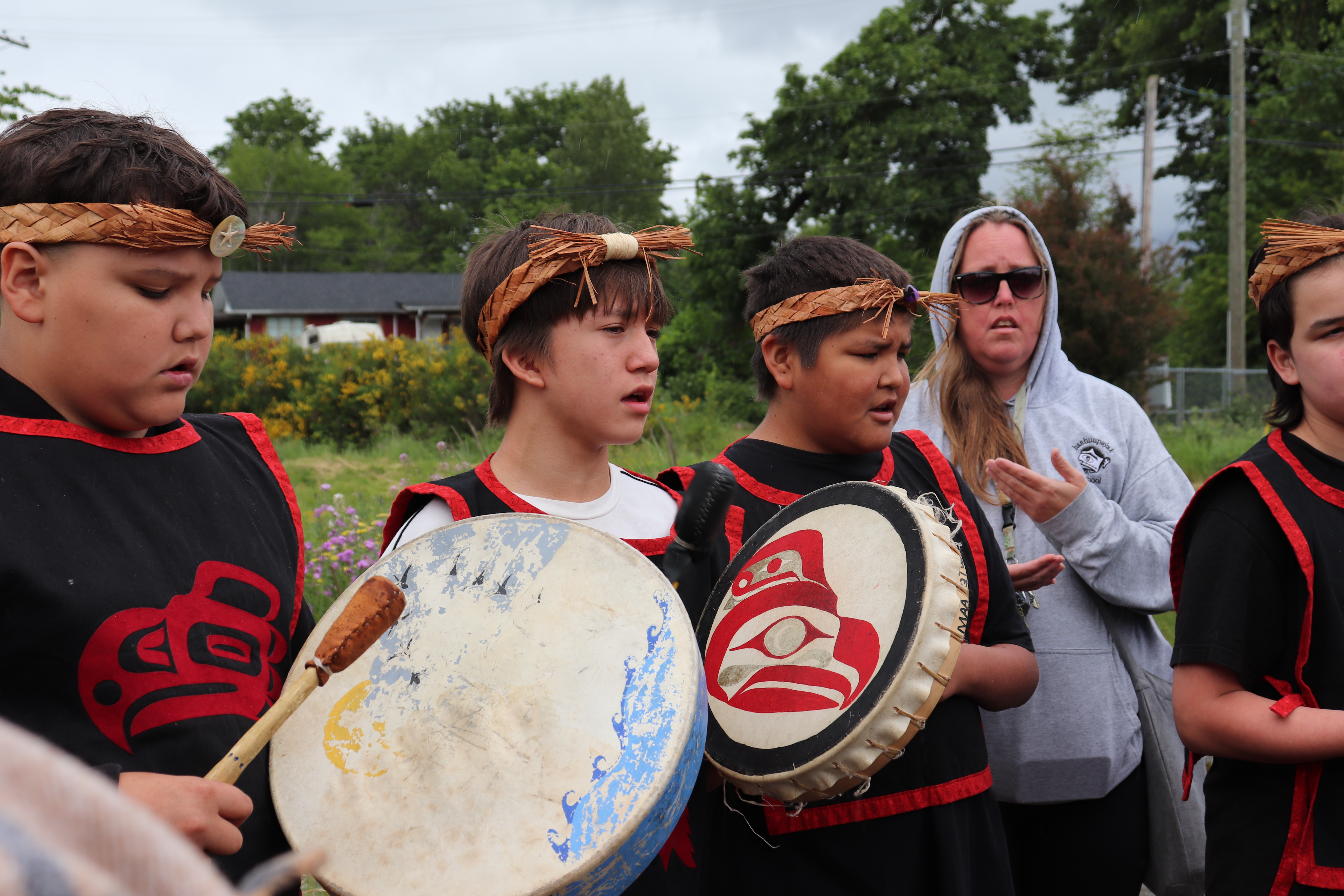
Gathered under shelters in front of the Indian residential school memorial sculpture, survivors were treated to a proud cultural performance by students of nearby Haahuupayak Elementary School who, according to cultural leader Trevor Little, credit survivors for saving the knowledge. For most of a century, a residential school stood at the site on the Tseshaht reserve, finally closing for good in 1973.
“Their strength comes from you and the generations before you,” Little told the small crowd.
But first, elected chief Wameesh, Ken Watts, took care of cultural business by offering a representative from Ahousaht, taʕałma (translates to walking stick), a handshake with cash, to show caring and support to the community as they grieve the loss of one of their Ha’wiih.
Following prayers and an uplifting cultural performance by the children, Watts made a statement about what the day was about. He said the discovery of 215 potential unmarked graves was a shock to the world, “but it was a statement of what many survivors already knew,” said Watts.
He went on to say that many know that what happened in Kamloops also happened at the Alberni Indian Residential School.
“We know that at least 67 students passed away here,” said Watts.
This is why Tseshaht First Nation is working on collecting information about the missing children, and sharing what they know with surviving family. Watts says the work is carried out with guidance from AIRS survivors.
“There are 17 potential unmarked graves (on the grounds of AIRS),” Watts shared.
He said the day was about remembering what happened and reflecting on it.
In recent years there has been a surge in denialism and racism in response to the continued news about residential schools. Watts thanked the survivors for standing up to it, cleaning up the orange bridge when it was vandalized. By doing that, Watts said they are showing their resilience.
The First Nations Summit released a statement on May 25 saying the path forward cannot be rooted in denialism.
In what they call a targeted rise in residential school denialism and anti-Indigenous racism in the province, “we stand with Tk̓emlúps and all First Nations in their paths toward healing and reconciliation.”
"Despite growing denialism, our communities continue to lead with dignity and an unwavering commitment to truth and healing. Reconciliation is not possible without honesty and without coming together to accept the shared responsibility and the hard work that meaningful reconciliation hinges on," said Robert Phillips, FNS political executive member.
According to FNS, there has been “a growing disinformation movement that manipulates well-established, well-documented facts about Canada's residential school system and the first-hand accounts from survivors, their families, and importantly, the first-hand accounts from the Crown itself.”
"Beyond accepting objective truths corroborated by the Crown's own documentation, there is a moral imperative to stand with survivors, bear witness to their truth, and more importantly defend it. Silence and denial continue to perpetuate harm and quietly permit these attempts to minimize the legacy of residential schools," stated Hugh Braker, FNS political executive member.
AIRS survivor and elder Wally Samuel has been part of the group that Tseshaht First Nation consults with as they carry out their healing work. He said the memorial sculpture created by Tseshaht artist Connie Watts was designed based on advice from survivors. He said another goal is to create a building that commemorates students and survivors, to be built hopefully next year.
Watts reported that the Caldwell Hall building, one of the last remaining structures that was part of AIRS, was to be demolished this year but there’s been a delay. He is hoping that it will be demolished next year.
There are plans to build a carving shed to memorialize those that didn’t make it home, according to Watts.
Samuel thanked Tseshaht First Nation on behalf of survivors, their children and grandchildren, for helping them on their healing journey.
“People need to know the truth so that it never happens again to our grandchildren,” said Samuel.
Survivors were invited to share stories – the awful memories, the family stories of brothers or sisters that went to residential school and were never seen again…nothing left of them but the stories.
There were those that learned pain, fear and abuse both at the school, and sometimes later, at home. One woman spoke of the repressed hate and rage she had to live with due to abuse she suffered, and how she has learned to embrace her genuine love for people.
Watts thanked them all for sharing their stories, for allowing Tseshaht to be part of their healing journeys.
They wrapped the event with uplifting cultural songs.