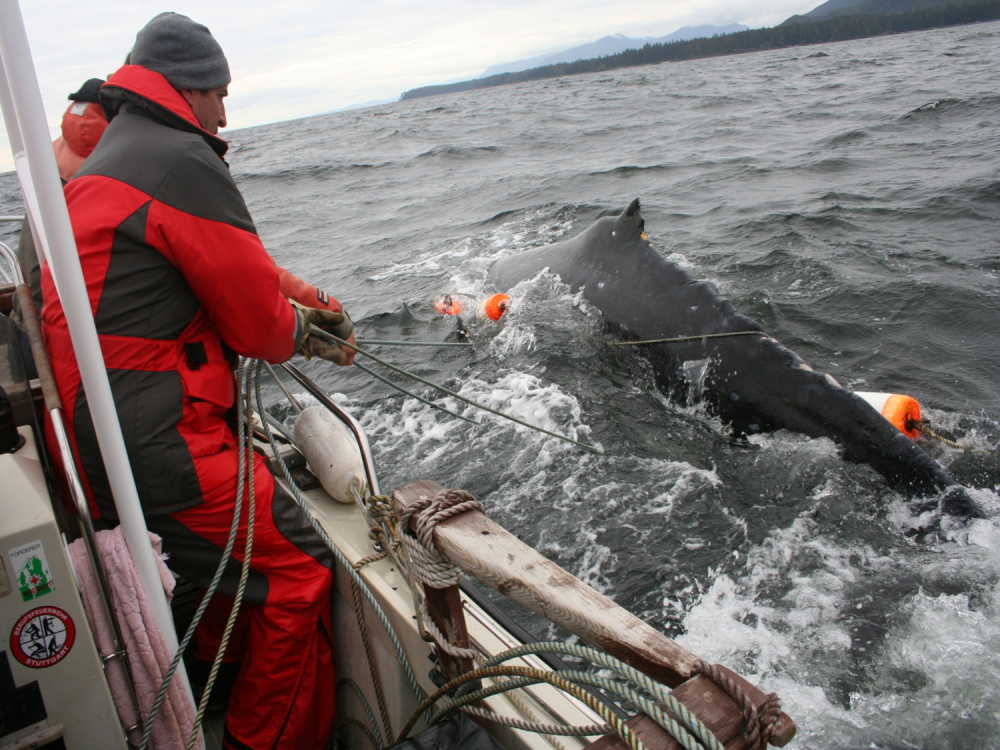
Vancouver Island has seen an increase in humpback whale entanglements within the last month - a rate abnormally high according to researchers.
For example, a humpback whale calf was disentangled from 300 feet of rope one week ago in southern Vancouver Island waters. Two humpback whales were rescued on the same day in the Salish Sea, between Lasqueti Island and French Creek. In June, Artemis the humpback whale was similarly entangled in heavy fishing gear and was freed in the Strait of Georgia.
Disentanglements like these are becoming increasingly more common, says Paul Cottrell, a marine mammal co-ordinator with Fisheries and Oceans Canada (DFO). Cottrell says he receives a call reporting whale entanglements once or twice a week, a rate that continues to increase.
“We’ve been hopping around,” says Cottrell, “and we’ve been really successful [in our disentanglements].”
Cottrell was just recently in Port Renfrew working with the Pacheedaht First Nation on a witness call about a whale entanglement. He was also present for the previous disentanglements across the Island, and almost every single one since May.
Both DFO and researchers trace whale movements by attaching a whale tag onto the buoys, while the DFO monitors humpback whales using drones. In the case of an entanglement a strategy is mapped out to free the whale, a process that has been successful thus far, according to Cottrell.
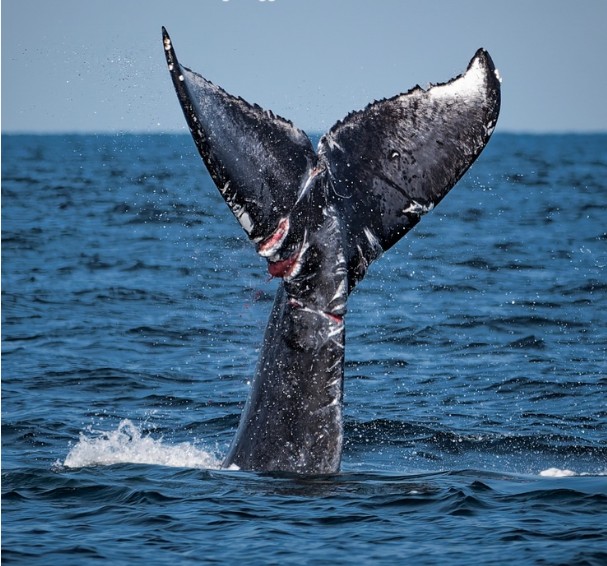
However, according to preliminary results from the Marine Education and Research Society (MERS) and collaborators, scarring has been observed on 50 per cent of humpback whales from at least one entanglement in their lives. The long-term effects of entanglements include deep punctures into the skin, restricting ways to eat and mobility – all detrimental to the humpback whale’s life. The exact effects of entanglements, however, remain a mystery. It is very rare to sight a whale after they’ve been disentangled.
Humpback whales have been making a comeback in Pacific inshore waters since the late 2000s. Previous whaling in the past century caused harmful, lasting effects on humpback whales, but after Canada added the cetaceans to the Species at Risk Act in 2005, more and more whales have been appearing on Vancouver Island coasts.
“Seeing [humpback whales] come back is amazing and I think it is also a sign of our productive ecosystems that are coming back as well,” said Cottrell. “But, the flipside is we are seeing more interaction with any [fishing] lines, ropes, or nets in the water because they’re in areas where 20 years ago they weren’t.”
The increase in whale entanglements is likely due to more humpbacks interacting with commercial and recreational fishing.
Dr. Rhonda Reidy, a researcher in humpback whale feeding habits, identified in her research that the whales are revisiting summer feeding grounds. Juan de Fuca sees solitary whales averaging a depth of 100 metres depth underwater, for example.
Science has yet to discover why whales are repeat visitors to the same location; whether whales have food preferences or favour a certain hotspot for its abundance in various aquatic critters remains a mystery.
However, both commercial and recreational prawn and crab fishing gear are being placed in the very same productive waters humpback whales frequent.
“Commercial and recreational fishers are targeting the same productive areas that the humpback whales may already know to explore from previous experience,” said Reidy, “they’re overlapping.”
Humpback whale researcher Jackie Hildering also identified the same overlap through her research. Hildering works as an Education and Communications director with MERS and studies entanglement scars left on humpback whales. She notes that whale entanglements have been happening, but the increase in incidents is caused by humpback whales returning in the dozens.
As critical as disentanglements are, Hildering believes that learning why the whales are getting caught is more important.
“You want to learn from every disentanglement. What was the source? What were the rafts like? What worked and didn’t work in terms of strategy … and did the whale survive?’” said Hildering.
Romanticizing disentanglements might perpetuate the problem of whales continually getting caught. If attention is directed towards the incidents, then there will be minimal research done to understand how and why whales become entangled in the first place, cautions Hildering.
Hildering focuses on reducing the overlap by attempting to educate what truly happens when a whale is entangled. MERS trains fisheries officers and they offer whale-safe boating courses, for example. Deglamorizing the heroic acts of unsafe and often fatal disentanglements is another way Hildering encourages folks to educate themselves on the reality of humpback whales.
A disentanglement is never done alone. The DFO also trains coastal First Nations how to attach satellite whale tags onto whales in an effort to better prepare people to safely disentangle humpbacks.
“It takes a community to do these rescues,” said Cottrell.
If you witness an entanglement, please call the 24-hour DFO incident line at +1 800 465 4336 immediately.