
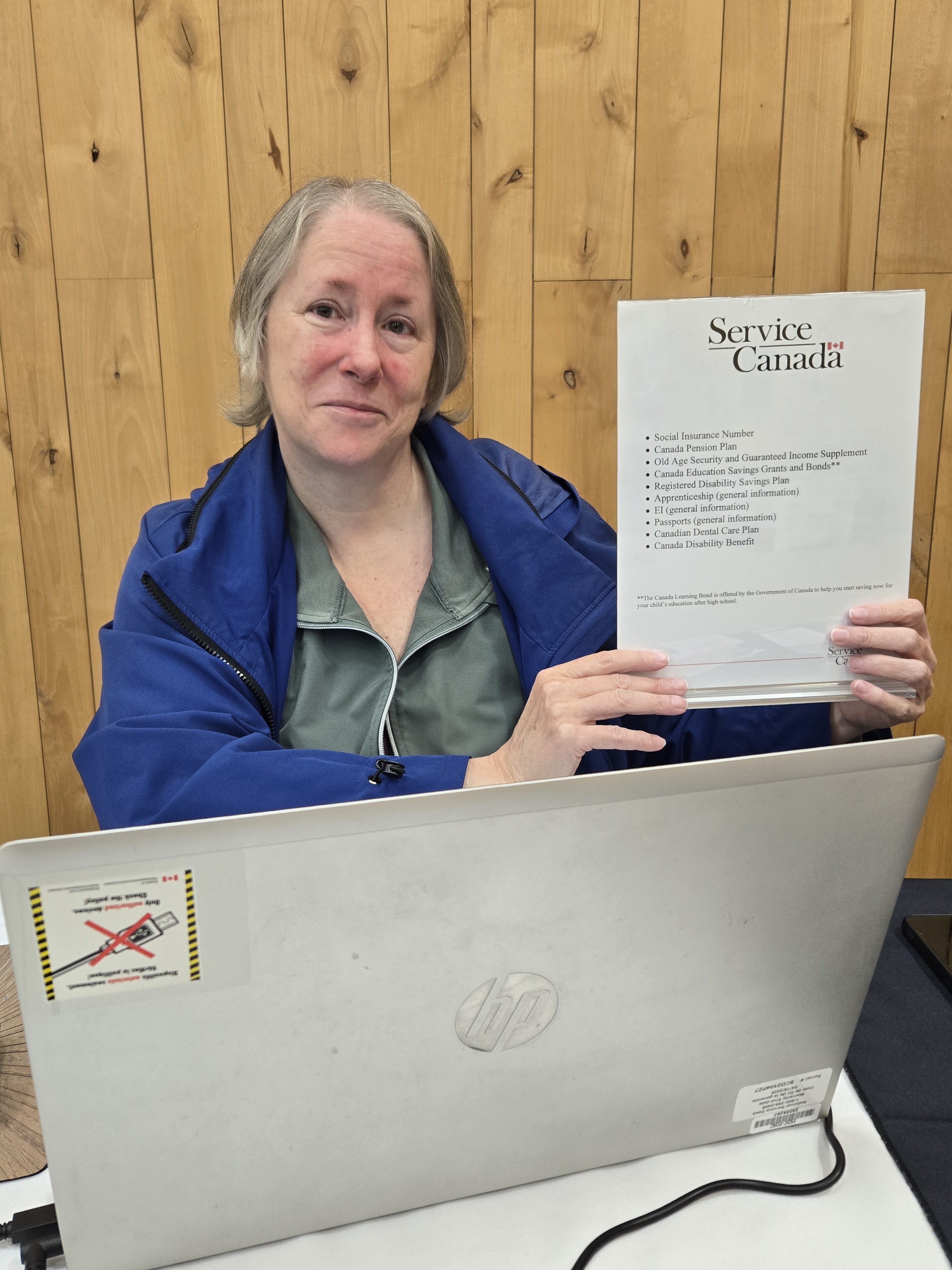
The NTC DAAC Health-ability Fair, held at the Alberni Athletic Hall on October 28 and 29, featured a wide array of health and support information for seniors and people facing extraordinary challenges. Besides health services information there were presenters sharing information specifically for seniors, including wills, powers of attorney and other legal and financial information important to seniors.
One of the presenters was from the Port Alberni branch of Services Canada. Tzena Russell, a Citizen Services specialist with Service Canada, delivered helpful information about Canadian pensions and benefits, including information for First Nations persons living with disabilities.
Starting with the Canada Pension Plan, Russell said that the amount of CPP a senior receives is based on information contained in employment and tax records.
“Every person over the age of 18 working for an employer pays into CPP, however, this does not necessarily apply on reserve,” Russell shared.
Prior to 1980, First Nations people working on reserve for the band were not allowed to pay into CPP. That law changed and some First Nations have opted in while others have not. This means that if you’re First Nations working on reserve and you don’t see deductions on your pay cheque for CPP, you are not contributing to the national pension program.
Further complicating the picture, each band employer has the opportunity to participate in the CPP, but that could mean only administrative staff and not other employees if all band businesses were not included in the CPP opt-in.
“For example, a band administration office may have opted in while their gas station business did not. That is one scenario,” Russell said.
CPP is, for most Canadians, deducted from pay starting at the age of 18. Both the employer and employee contribute to CPP. The contribution amount is based on a percentage of wages. If an employer does not opt in to the CPP, an individual can choose to do so.
If you are self-employed or want to opt into the CPP as an individual, you must file your taxes and pay into the program at that time.
Important to know is that CPP is taxable income, however, if you worked in a situation where your pay was not taxable, that makes a difference on how much tax can be deducted from your CPP payment.
Russell explained it this way: “For example, if you worked at a non-taxable job for a decade and then 30 years paid income tax, you pay income tax on the portion of pension that was taxable, (this scenario amounts to) 75 per cent.”
Canadians may start collecting monthly CPP as early as age 60, however, your payments will be lower than if you waited until the age of 65 or even 70.
“The longer you wait, the higher the benefit,” Russell stated.
CPP payments sometimes increase, which is based on the Consumer Price Index calculated in December, with a possible cheque increase coming the following January.
“If you take your pension early, it will remain the same rate. It will not increase when you turn 65,” said Russell.
You may take your pension early, anytime after age 60 and continue to work and contribute to the CPP.
“If you take it early but continue to work and pay into it, it will increase,” Russell said.
The increase comes from what is called the post-retirement benefit. After you file your taxes, calculations are made on the amount you paid into CPP that year and an increased payment will follow, likely in March or April.
Consideration for child rearing
Another way to potentially increase your pension payment is called the Child-Rearing Provision. The federal government recognizes that raising children is expensive and they may look back on your taxes from when your children were young to determine if recalculating your taxes can increase your CPP benefits.
“We look at the years when your children were under age seven,” Russell said. “If you were low income, we may be able to recalculate your benefits. Only one parent can use this option.”
There is a death benefit available at Service Canada that is a one-time, $2,500 payment to help cover funeral expenses. For single people that haven’t already collected a spouse’s death benefit, this could double to $5,000.
The Survivors Benefit is available to the surviving spouse of someone that had paid into the CPP during their lifetime. The eligible survivor is defined as the person that was in the most current relationship of deceased spouse, and that includes a common-law partner.
“It goes to the person with the most recent marital status,” said Russell.
Old Age Pension is a Canadian benefit for seniors that starts at age 65. According to Russell, the OAP rate has risen from $742 to $751 per month.
If you decide to leave Canada, your OAP can follow you to your new country if you have lived in Canada for at least 20 years. If not, your benefit will be cut off.
“If you go to prison – no pension. If you pass away or leave the country without 20 years of employment, your pension will stop,” Russell advised.
The Guaranteed Income Supplement is another benefit that Canadian seniors may apply for. It supports low-income seniors struggling to make ends meet.
Russell advises all seniors to apply for GIS, even if they know their income is too high to receive it.
“If your income is too high, you won’t get a benefit, however, if your income goes down, you will automatically be paid the benefit, because you already applied for it,” she shared.
For more information about federal seniors benefits, visit your local Services Canada Centre and speak to an agent.
It is important to file your taxes every year so that you can apply for all the benefits you may be entitled to.
Seniors may also call the Service Canada Support Centre with questions.
“They have lots of general knowledge regarding programs and services,” said Russell, but sometimes you may be sent to other experts for more complicated questions.
Service Canada has a website where information can be found along with other contact information. If you’re comfortable using a computer, you can open a My Services Canada account, which will allow you to access your benefits information. But if you’re not comfortable using a computer, it is probably not a good idea to use the My Services Canada option.
“The site goes down once in a while and the log-in requirements change from time to time, but it is a good tool – if you’re comfortable with computers,” said Russell.
Port Alberni’s Service Canada Centre, located at 4805 Mar Street, is open Tuesdy to Friday from 8:30 to 4:00. The Service Canada website, at https://www.canada.ca/en/employment-social-development/corporate/portfolio/service-canada.html contains the most current information.