Optimism for the future of Chinook salmon is swimming up Muchalat River near the town of Gold River, B.C. in Mowachaht/Muchalaht First Nations (MMFN) territory.
Kent O’Neill, president of the Nootka Sound Watershed Society (NSWS), says he observed hundreds of fish using a newly restored gravel spawning pad at the outflow area of Muchalat Lake this fall.
“It’s really encouraging for the first year. They’re figuring it out. It just takes a few generations, and they’ll figure out that this is one of the best spots in the whole system to spawn and they’ll all start showing up,” said O’Neill.
Navigating a storm of challenges from historical logging practices that destroyed stream banks to droughty summers, Chinook salmon in the region were assessed as Threatened by the Committee on the Status of Endangered Wildlife in Canada in 2020.
To revive local Chinook salmon stocks, a collective effort led by NSWS, Ecofish Research, a Trinity Consultants Canada team, MMFN and the Pacific Salmon Foundation (PSF) was hatched.
PSF provided $560,000 in seed money to support the project and other partners raised an additional $740,000 for the project, bringing the total price tag for this first-of-its-kind project up to $1.3 million.
“This project is a big deal,” said Jason Hwang, PSF program officer and vice president, in a media release. “It’s a big deal in terms of the money going into it, but it’s also going to be a big deal in terms of the benefits to salmon and to this river.”
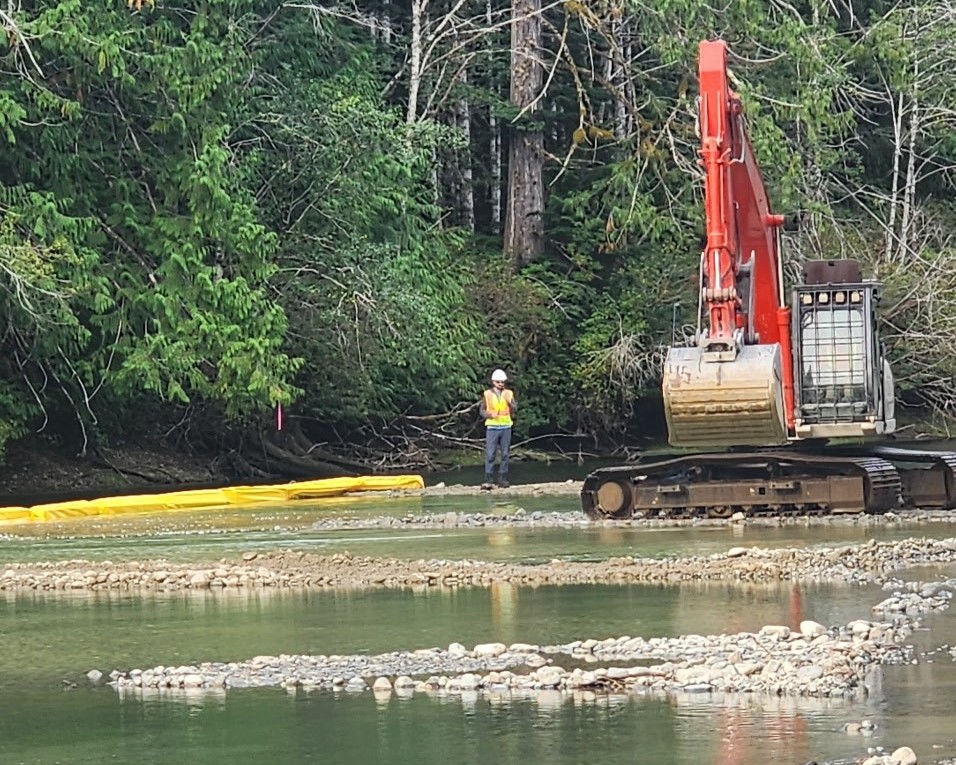
Enhancement of the critical spawning site in the Muchalat River began in August 2025 and was successfully completed in early September 2025 – just in time for the keystone species to spawn and lay their eggs.
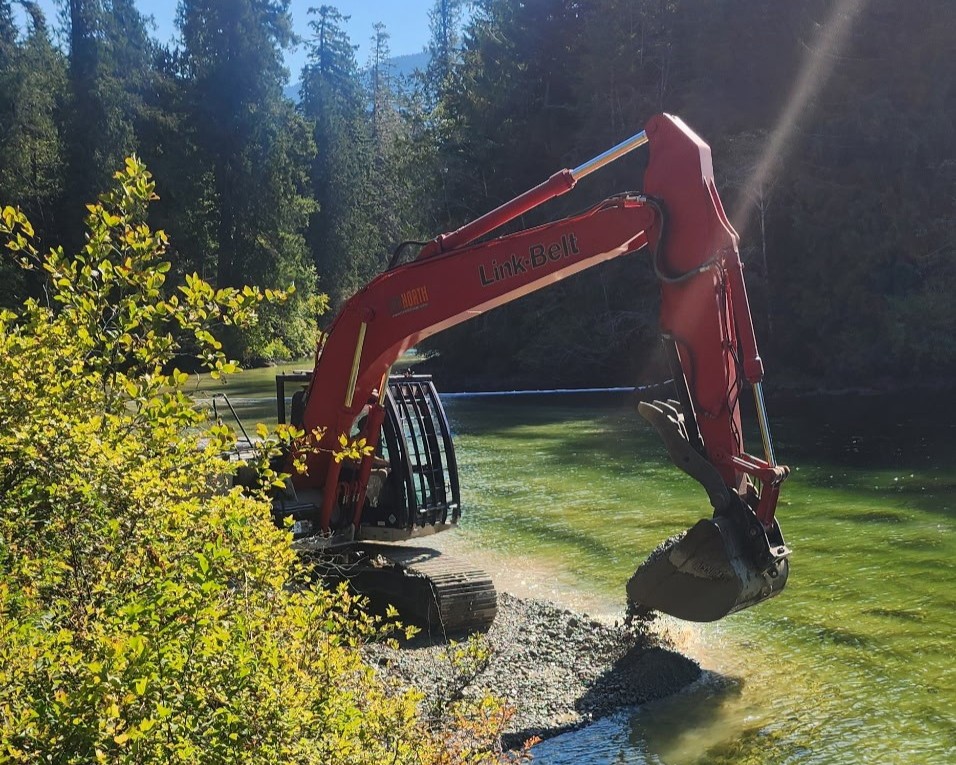
Designed by hydrologists and geomorphologists, the 200-metre long spawning pad was constructed by hauling in 2,000 cubic metres (roughly 200 dump trucks) worth of high-grade spawning gravel. The gravel was screened, mixed and sorted uniquely for Chinook and Sockeye.
“The Chinook mix is in the centre of the pad going down the river and the Sockeye is along the two edges,” said O’Neill. “We had a University of Waterloo student doing her master’s dissertation on gravel movement with high water levels doing research, so we knew what the risks were when we placed it. It’s been quite a collaborative process.”
Western Forest Products (WFP) also played a major role by providing in-kind donation of the gravel and access to the forest service roads.
“They provided probably one of the most significant contributions to the project. We wouldn’t have been able to do this project without Western Forest Products,” said O’Neill.
MMFN marine biologist Vanessa Moll says the restoration project was the brainchild of NSWS and Roger Dunlop, who now heads up the lands and resources department for the neighbouring nation of Nuchatlaht.
Moll is advocating for additional studies to monitor and quantify future runs, but anecdotally, said she’s already noticed a positive change in the surrounding environment and stream itself.
“It’s important to keep in mind there is a lot more impact that human activities have on the environment than we realize,” said Moll. “It’s nice to see that there is a pivot towards both protecting salmon when they’re in the ocean but also making better habitats for them to be able to bring back their populations.”
In 2023, MMFN was awarded $15 million from the federal government for a Salmon Parks initiative designed to change the tide of industrial forestry activity in Nootka Sound. The majority of this government funding was put towards land acquisition costs, such as the buyouts of tenures held by forestry companies on Crown land.
Major funding scale-backs reportedly on the horizon for Fisheries and Oceans Canada (DFO) could impact the capacity of this special restoration project, says Moll.
“We are always watching the funding (DFO) provides,” she said. “We don’t want there to be a shift away from the capacity to have these programs and keep track of the fish populations.”
O’Neill agrees that the DFO funding cuts are concerning, as is the increased competition to funding streams, but he emphasized the strength and importance of the partnerships.
“Salmon is a unifying force. If we are applying for funds together, we have better traction. It’s a much more powerful message if we are trying to do it together,” he said.
O’Neill said they had to acquire 17 different permits to get the project approved, and everybody along the way thought it was a great idea.
“It’s a win for salmon, but more importantly it’s a win for everybody in this community,” he said. “There is no shortcut in restoration work. It always comes down to the right partnerships.”
Nootka Sound Watershed Society anticipates the improved spawning habitat will significantly increase the number of fish annually spawning at the site to about 1,000 to 2,000 adult Chinook salmon. O’Neill says at capacity it could hold up to 4,000 fish.
It’s hard to know the origin of the fish using the new spawning pad, whether they’re natural spawners or enhanced fish from the nearby hatchery, O’Neill explained.
“All the enhanced fish are now adipose clipped, so we’ll know moving forward which fish are native spawners,” he said.
The second stage of the project is slated for 2026. The team will plant trees along the Oktwanch River that connects to Muchalaht Lake and build an additional constriction feature to help retain water at the site, which is intended to protect the new spawning channel from drought and heavy rainfall.
“We’re never going to get old growth trees again, but we’ll get large trees, eventually. It’s a long play. The science all says nature heals itself given the chance,” said O’Neill.
This salmon restoration initiative is located on Tree Farm Licence (TFL) 19, a tenure held by WFP.
- With a file from Eric Plummer