After being closed for a year, the iconic Juan de Fuca Marine Trail is expected to be accessible to the public this summer with the reopening date to be announced in mid-May.
The Juan de Fuca Trail, one of B.C.’s most popular coastal hiking trails, receives thousands of visitors each year. The trail is in the territory of the Pacheedaht First Nation, which holds deep cultural significance for their community.
The 47-kilometre trail suffered extensive damage after a series of winter storms between 2024 and 2025, and a closure has been in place since April last year. The affected areas spanned from China Beach to Botanical Beach, leading to the closure of backcountry campgrounds at Bear Beach, West Sombrio Beach, Little Kuitsche Creek, and Payzant Creek.
“It has affected the local area. There are so few opportunities for public access, a lot of recreation done that is semi-trespass, because the land is private, owned by the forestry companies,” said Rosemary Jorna, director of the Juan de Fuca Community Trails Society. “But actual public trails are the Juan de Fuca Trail, and that’s fragile, as shown by the destruction from the storms that we had.”
The storm washed out sections of the trail, toppled trees and created unstable slopes that made areas impassable or unsafe for hikers to cross. Multiple bridges, boardwalks, shelters, campsites and other structures were damaged.
“Major, complex repairs could not begin until engineering and geotechnical assessments were completed, and a detailed scope of work, funding, and contracts were in place,” the Ministry of Environment and Parks said in a statement.
Due to the extent of the damage and the challenging backcountry terrain, repairs took time.
The Pacheedaht First Nations works in partnership with BC Parks on the management of the park, including operational logistics and the scope of work for storm-damage repairs. Together, there has been considerable progress in repairing critical infrastructure essential for safe public access by prioritizing trail and bridge facilities.
The Ministry of Environment and Parks had to carefully plan the restoration to ensure public safety, while minimizing impacts on sensitive habitats and ecosystems.
The estimated cost of repairs is approximately $950,000, with the Government of Canada’s Disaster Financial Assistance Arrangements Programs providing most of the funding.
Administered by Public Safety Canada, the program provides financial assistance to provincial and territorial governments for response and recovery costs from large-scale disasters caused by natural hazards.
The restoration process was completed in phases, with priority given to the major infrastructure required for safe hiking along the full length of the trail.
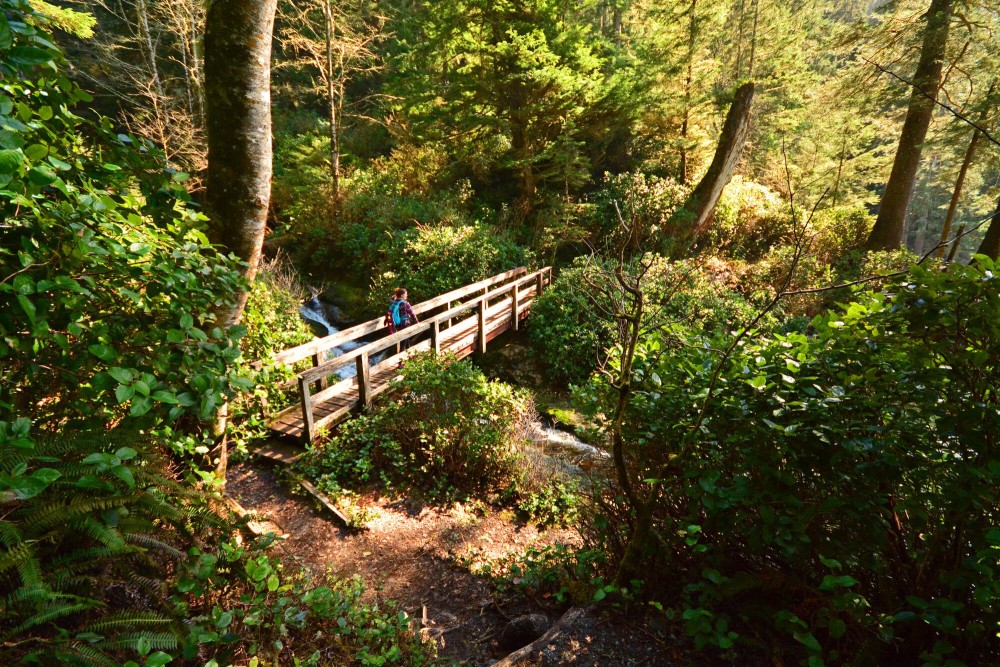
At times, major restoration efforts had to be flown in. Seven engineered bridges were installed, from small creek crossings to larger spans designed to withstand storms.
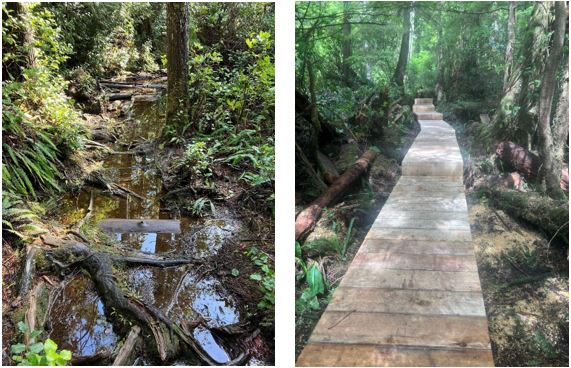
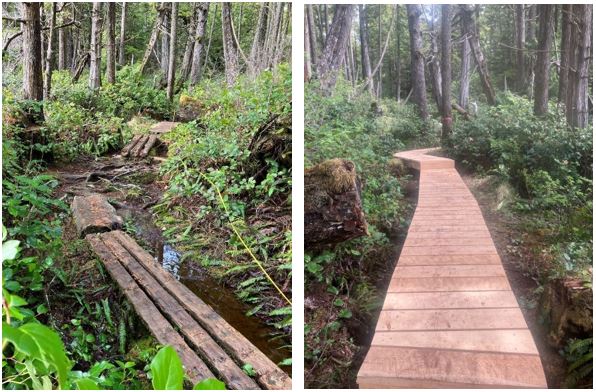
Other tasks involved constructing more than 800 meters of boardwalk and multiple staircases on steep and unstable terrain.
The trail had to be rerouted to several locations to bypass areas affected by landslides, erosion and ongoing slope instability, ensuring a safer and more sustainable route for hikers.
Minor repair to existing infrastructure will continue throughout the summer and fall while the trail is open. These include resurfacing worn or eroded sections of trail, repairing or replacing damaged railings and small bridge components, and improving drainage to prevent future washouts.
“The trail is mostly gravel. You have in one stretch of seventeen points where you have to go up and down on a gravel spine towards the water,” said Jorna. “Then you have logging up the trail, heavy rain and storms. [If] the footing isn’t good and it becomes very poor, then people start making their own desired routes, causing more erosion.”
Additionally, repairs will focus on rebuilding short sections of trail affected by fallen trees or erosion, installing additional steps and boardwalk segments, and reinforcing trail edges in areas where footing has been compromised.
While it’s difficult to know precisely how many hikers and campers are expected to visit the trail this year after its reopening, the Ministry of Environment and Parks estimated a total attendance of 506,061 visitors at Juan de Fuca Park between 2025 and 2026. This was a noticeable decrease from the 586,030 visitors reported between 2024 and 2025 at the Juan de Fuca Park, due to limited access to the trail last year.
“It has had an effect on tourism,” said Jorna. “I checked with the local tourism bureau, and we had people from Germany and Australia asking if the trail was open. Of course it’s not [open yet].”
“Everyone is feeling relieved with their own hiking and for the boost in tourism in this area,” she added.
Jorna, along with a party of six people, is planning to hike a segment once the trail reopens, sharing the enthusiasm of hikers and campers both locally and internationally.
For the past six years, the British Columbia government has been upgrading the trail to improve safety, support sustainable infrastructure, and enhance hikers’ experiences. Over this time the province invested $2.1 million in new bridges, boardwalks, stairs, and food catches at multiple locations along the trail. In 2023, $905,000 was invested in 50 new tent platforms across backcountry camping areas, along with additional infrastructure improvements.
The Ministry of Environmental Parks advises hikers to use caution, follow the signs, and be prepared for momentary delays, as the crew will continue working to improve the trail’s safety and long-term durability.
“I hope that people will respect the instructions on the trail,” said Jorna. “I’m delighted that the trail will be opened. I wish there was a possibility - and I hope there will be - the acquisition of more parks and protected land between Sooke and Port Renfrew.”
For more information about the trail and timelines, please visit: https://bcparks.ca/juan-de-fuca-park/