
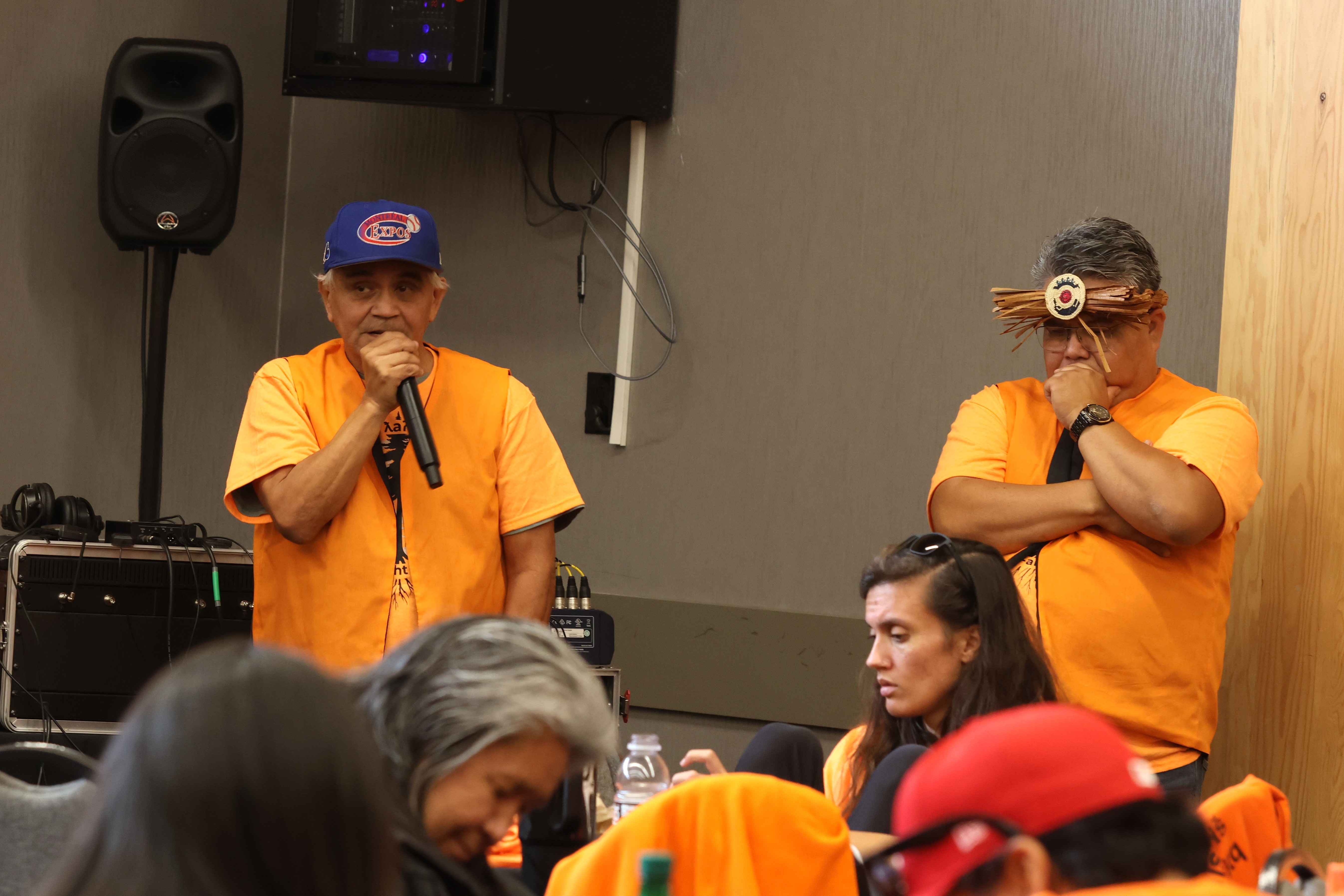
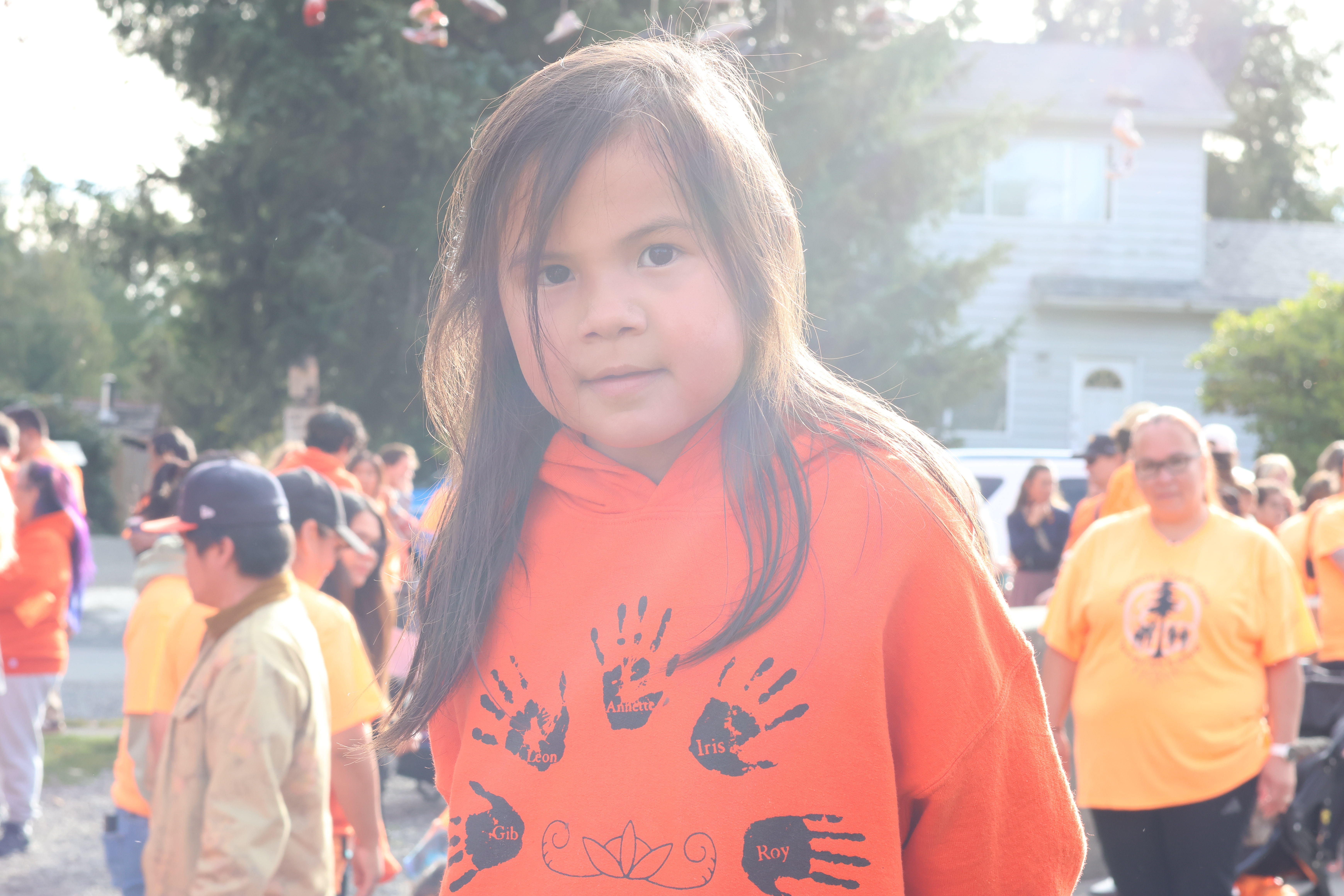
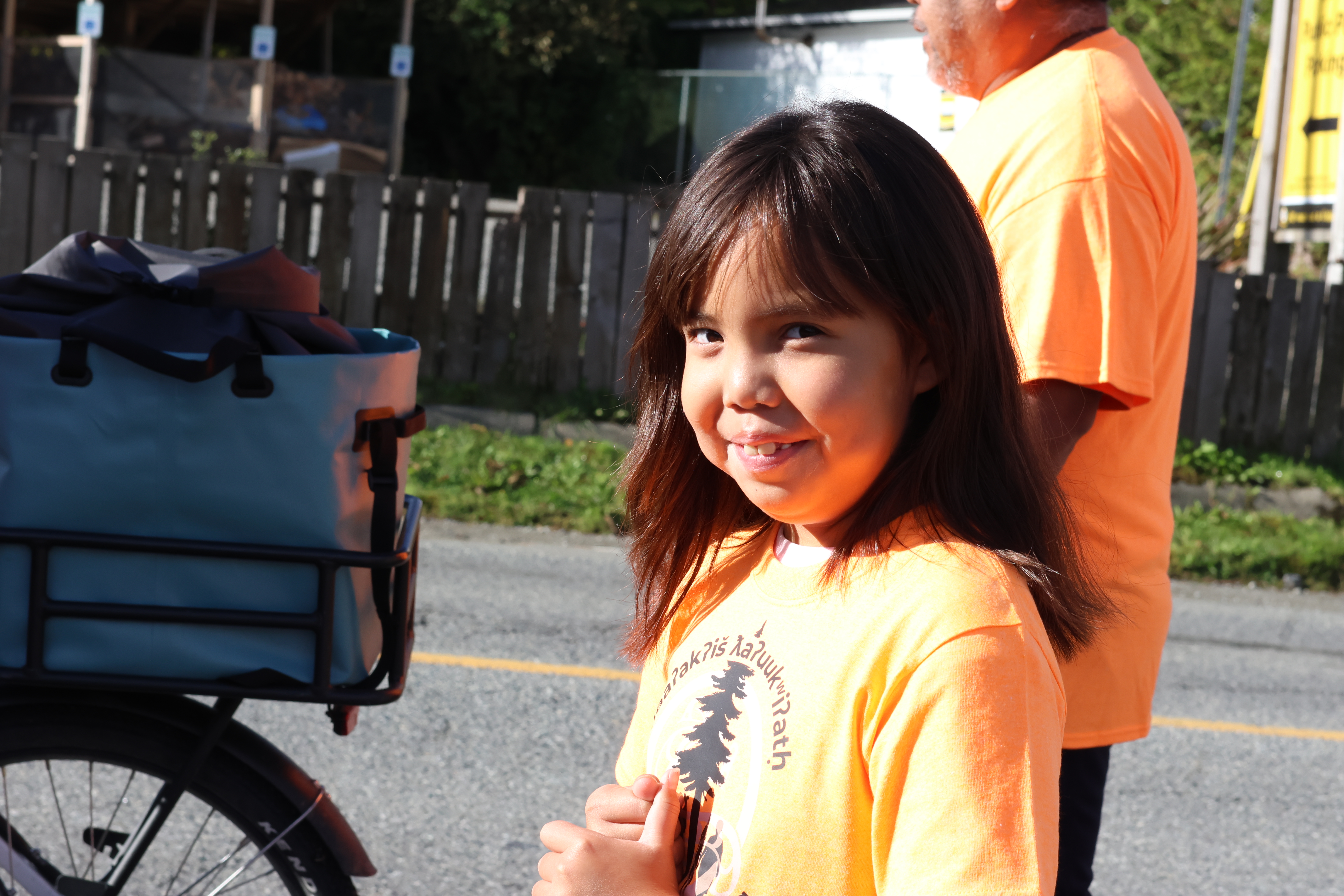
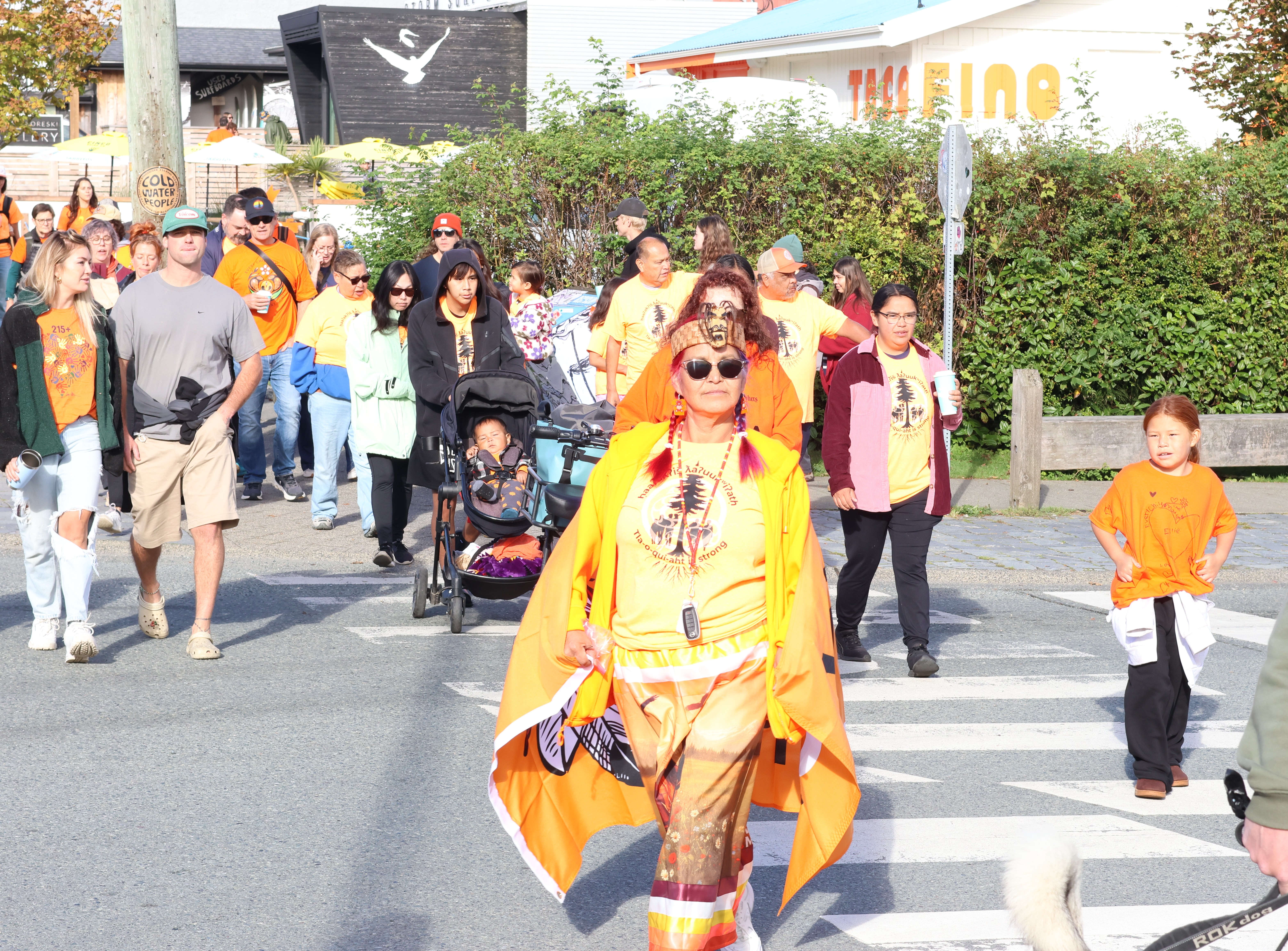
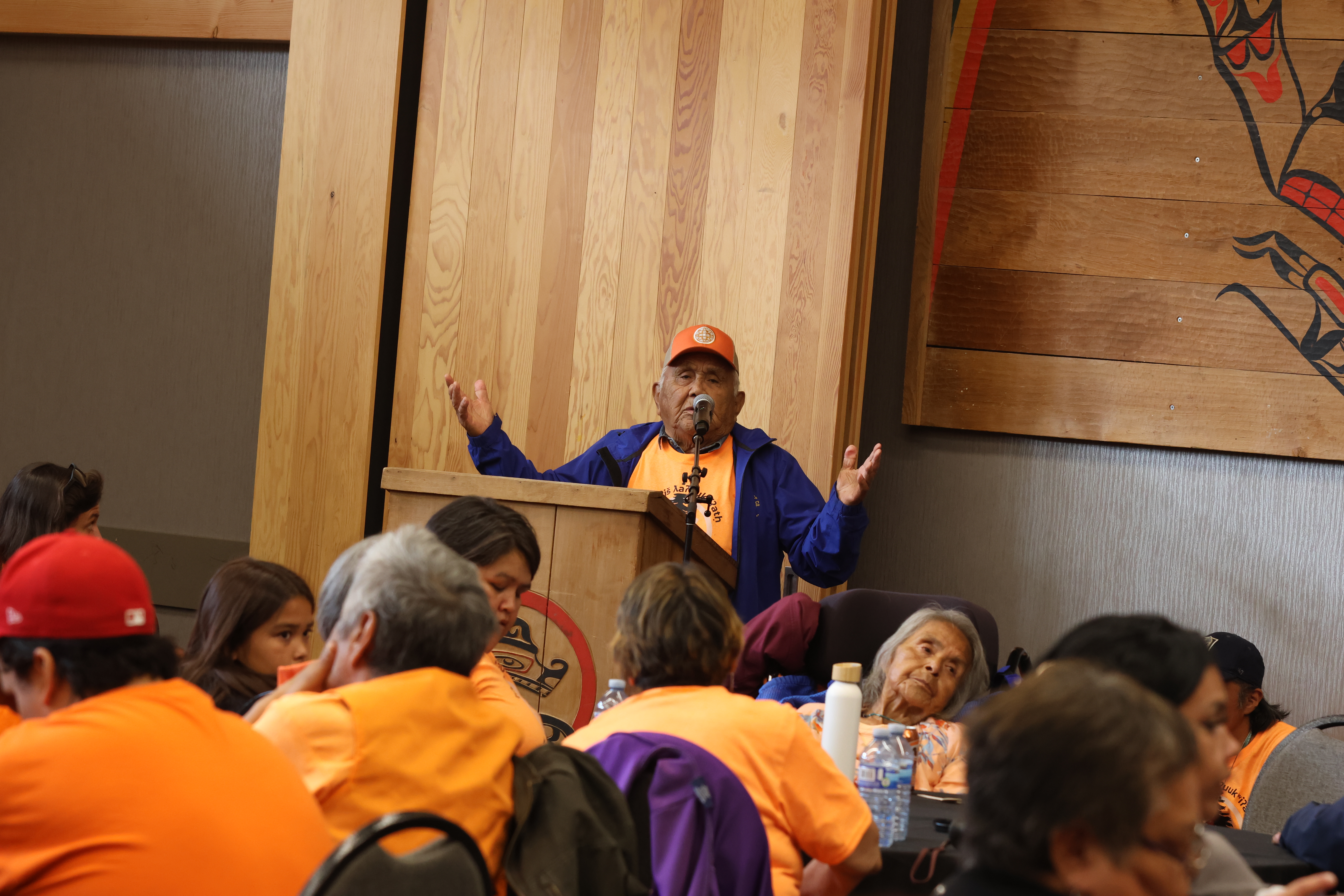
Survivors of crimes committed by the Roman Catholic Church and the Government of Canada gave personal oral testimonies, recounting memories of rape, neglect and physical abuse, as children romped carefree around an orange room and babies slept in arms.
A Tla-o-qui-aht artist scrolled the words “Truth and Reconciliation” across a blank canvas and got to work drawing a drum circle and orange human figures walking together in the same direction.
Orange Shirt Day at the Tin Wis Resort in Tofino on Sept. 30 was elbow-to-elbow with supporters, but Tla-o-qui-aht councillor Autlieyu (Francis Frank) spoke about the event being only half full.
“Where are the representative from the Oblates? That’s who put the hurt and the pain on us, the nuns and the priests. How do you reconcile if the other half is not here to reconcile with you?” said Autlieyu, who lived at residential school for nine years and then grew up in foster care.
“They need to take ownership. So, to the non-First Nations that are here, we ask of you, put pressure on the churches, put pressure on the politicians. They should be hosting this. We didn’t do this to ourselves. It’s not our behaviour it’s a learnt behaviour. We were taught to not talk to our sisters. We weren’t allowed to. That’s the impact of residential school, we were taught not to love,” he continued.
“The perpetrators, the people that caused the pain, have to take responsibility and be here to start to go down that path of real reconciliation. Right now, reconciliation is hollow. It means nothing,” said Autlieyu.
Christie Indian Residential School opened on Meares Island, off the west coast of Vancouver Island, in 1897. Children taken from their families to fill the institution came from Ahousaht, Tla-o-qui-aht, Hesquiaht, Ehattesaht, Mowachaht/Muchalaht, Kyuquot and more.
The National Centre for Truth and Reconciliation (NCTR) has a list of names of children that died at Christie.
According to the NCTR, Christie Indian Residential School was funded by the Government of Canada and operated by two Roman Catholic Orders: Order of St. Benedict (1899 – 1938) and the Missionary Oblates of Mary Immaculate (1938 – 1969) under various names. It was commonly known as Old Christie or Kakawis.
The federal government took over the management and operation of the Old Christie on April 1, 1969, according to the NCTR. In 1971, the Old Christie on Meares Island closed and relocated to the Christie Student Residence in Tofino at the site that is now Tin Wis Resort in Tla-o-qui-aht traditional territory.
New Christie Residence closed in 1983, making it the last of the Indian Residential Schools in the province of British Columbia.
On Oct. 9, 2025, dozens of Survivors witnessed the demolition of the Old Christie gymnasium at a healing event hosted by the Ahousaht Residential School Research team along with Ahousaht Haw'ił (hereditary chiefs).
Tla-o-qui-aht elected chief Elmer Frank said many Nuu-chah-nulth members also went to Kamloops Indian Residential School.
“We think we are moving ahead as a community, as a nation, healing. Internally, we see that. Externally, we face more traumas when we come into situations like our families and relatives in Kamloops having to face Second Sons opening wounds and pouring salt deep into our wounds,” said Frank.
On behalf of Tla-o-qui-aht Haw'ił, Frank welcomed and thanked the crowd for showing up to walk with the Survivors and to honour them.
“We stay united as we suffer from the residential school trauma. It was heartwarming to our chiefs to see the amount of people that are here with us,” he said.
During the 3.4 kilometre walk from Tofino’s Village Green to Tin Wis Resort, Palexelsiya (Lorelei Williams), Indigenous activist and founder of the dance group Butterflies in Spirit, spoke out against racism in Canada.
“The fact that those people are coming out and saying, ‘Got bones?’, it’s very frustrating that they are doing that. There are protocols, it’s a process. You can’t just go and start digging. There is a respectful way to do it. We have our elders’ stories as well,” said Palexelsiya, who was wearing an Orange Shirt depicting a photo of her parents, both survivors of St. Mary’s Residential School near Mission, B.C.
Overlooking the Tofino harbour along the multi-use path, Tofino Mayor Dan Law said Orange Shirt Day is a day to reflect and a day to recognize the power of Tla-o-qui-aht in Tofino.
“Part of the reconciliation process is overcoming a history of racism and discord. We are all here. We are all neighbours and friends, and we have a bright future together. That’s what we have to work towards. It is going to take a lot of work and we have a lot of things to overcome, but if we do it in the spirit of friendship then there is hope,” said Law.
Later in the day, Tla-o-qui-aht and the District of Tofino signed renewed friendship agreement. The agreement acknowledges Tla-o-qui-aht as the original inhabitants of the lands in which Tofino exists within.
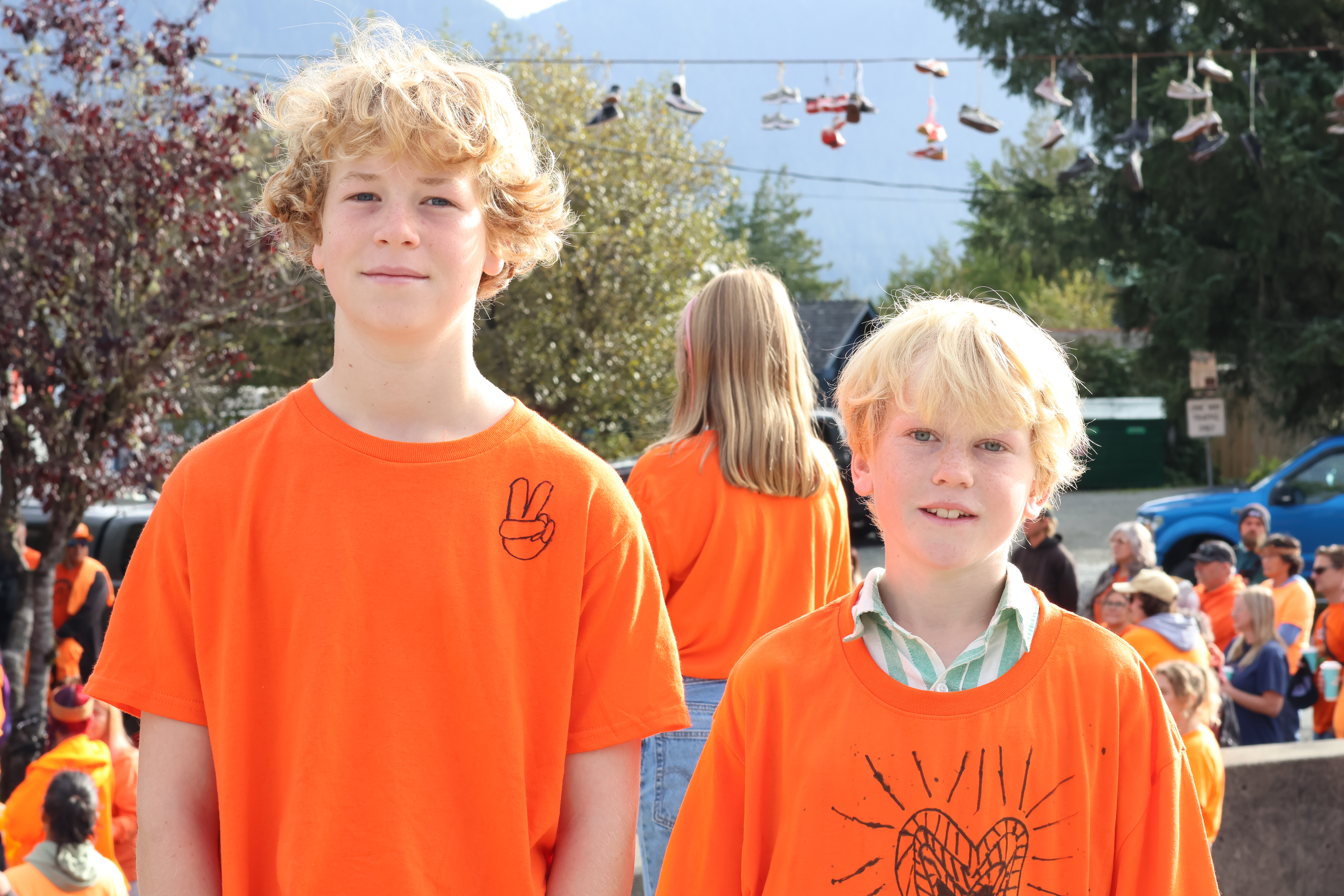
Tourism Tofino’s executive director Samantha Hackett brought her daughters to the Orange Shirt Day event.
“It’s not a day that is recognized worldwide. It’s really about Canadian history, it’s about British Columbia’s history and more locally it’s really about what happened here within Tla-o-qui-aht territory and surrounding communities,” said Hackett.
She told the Ha-Shilth-Sa she hopes visitors to the region “learn and acknowledge the history and get to know the full story.”
Travellers Svitlana Kyniv from Ukraine and Fernanda Soto from Chile joined Tla-o-qui-aht’s Orange Shirt Day walk.
“We were glad to support the walk and support the resilience of the First Nations people,” said Kyniv.
“After learning the meaning of the T-shirt, it was really sad,” said Soto. “For that, we are here supporting. Also, in my country we have a similar situation when Spain colonized Chile.”
Wearing a cedar headband made by her mom, Rose David shared that she is a descendent residential school survivors.
“I’m doing this for my parents. Don’t be ashamed of where your parents come from, and love everybody for who they are,” said David.