
A salmon genome testing project is in development to enable First Nations ownership over data testing tools, aiding in fisheries management and conservation decision-making.
A multi-partner First Nations project is being developed on Vancouver Island’s west coast. After securing three years of funding, the Ahousaht, Ehattesaht, Mowachaht/Muchalaht, Hesquiaht, and Tla-o-qui-aht First Nations are building capacity in salmon genome testing technology and infrastructure.
“The ultimate goal is true co-management between the five nations, being able to show their authority towards fisheries management and with the power to produce the data and own the data,” said Candace Picco, senior biologist at the Ha’oom Fisheries Society.
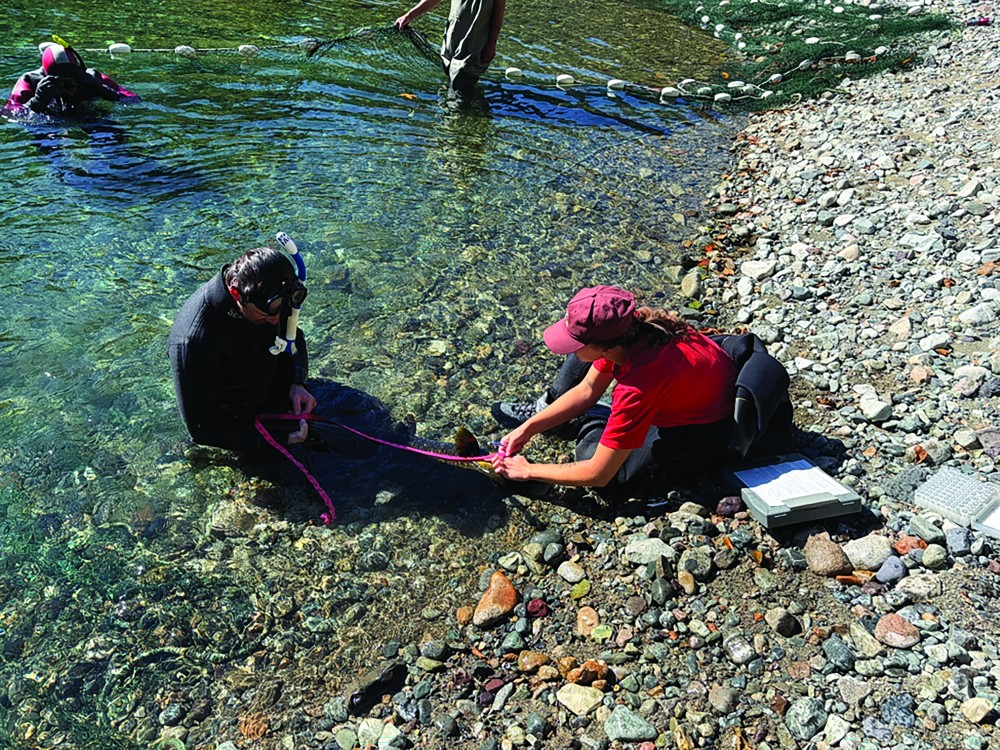
Genomics studies an organism’s DNA, its functions and the specific genetic adaptations that improve survival in certain environments. Researchers use salmon genomics to identify a fish’s origins, the hatchery it was released from, its parentage and its age - data crucial to salmon management.
“Genetics can inform your rebuilding strategies depending on what you find,” said Jared Dick (Whehs-Wiss-Sunup), Central Region fisheries biologist for Uu-a-thluk, adding that DNA analysis could reduce the number of fish originating from a hatchery, while provide data that helps to promote wild stocks.
Currently the Canadian West Coast relies on a single lab for salmon genomics testing and analytics: the Molecular Genetics Laboratory at the Pacific Biological Station in Nanaimo, run by Fisheries and Oceans Canada (DFO).
Over the decades, the Nanaimo lab has built an extensive library of salmon genomics data from populated streams along the coast. It can compare a sample against 550 genetic markers in the library to figure out a fish’s native region.
However, demand for genomics analytics has long outpaced the lab’s capacity, resulting in long wait times since the early 2000s. Delays are worse in remote areas, where distance adds time, which is a problem for fisheries managers who need timely results for decision-making.
To cut down wait times, the five nations are building their own genomics lab, which will allow them to test fewer samples in less time, reduce processing bottlenecks, and let users, especially First Nations organizations, set their own priorities to manage data independently.
Picco reached out to Ben Sutherland, an adjunct professor at Vancouver Island University and founder of Sutherland Bioinformatics, to work out how to successfully genotype fish samples outside the DFO.
There are two parts of the project.
First is developing remote genotyping capability by using a hand-held Nanopore sequencer. A sequencer of any size is a tool to help humans read the data stored in a genome.
The Nanopore sequencer is the size of a staple, needs to be connected to a laptop and costs under $10,000 to run — a cheaper and smaller option than the one used in the DFO labs.
“We've started sequencing on the nanopore at VIU in a nice clean lab environment, and then we'll slowly get closer and closer to genotyping in the field . . . [like] in Tofino [to] demonstrate that we can do it there,” said Sutherland.
Buying a larger sequencer would require more funding, space, and trained personnel to run and maintain it, and it can’t be used outside the lab.
One downside of the Nanopore sequencer is that it processes fewer samples than a larger one. Second, the team has to work on the sequencer to produce the same results as the DFO equipment, since different sequencers should yield the same data from the same sample as the genetic baseline doesn’t change.
“We need to make sure that those results keep matching what we expect them to because if we can’t, it’s like apples to oranges,” said Sutherland.
The second part of the project involves building analysis software that can successfully compare the results to the DFO library. The DFO fully supports the project by checking that results from the Nanopore sequencer are compatible with its existing database.
However, the project has not yet shown that the Nanopore sequencer produces the same results as the DFO lab.
Once the project is refined and ready for the field, the genomics analysis will focus on coho and chinook as the two main kinds of salmon harvested on the west coast of Vancouver Island.
The project began with a court case in which the five nations asserted their right to run the fisheries in their territories based on their own priorities. A judge required DFO and the nations to work together to manage fisheries based on the nations’ needs.
However, knowing which salmon stock is being caught is key to running a fishery.
“Candace started this project with VIU and other partners to develop capacity within the nations to run their own genetic samples,” said Dick. “Because if we have the tools and the means to collect samples and run them, we can get results on any of the samples we collect... and we don’t have to get permission to see if the lab has capacity.”
Picco secured funding from the Indigenous Stewardship Fund (providing $365,000 for three years), the Pacific Salmon Foundation and Genome B.C.
The project has captured the attention of other First Nations. The development hopes that by the end of the three years, Ha’oom scientists will be fully trained in processing and sample analysis, the hand-held Nanopore sequencer will support remote genotyping within a few days, and the lab will produce results comparable to the DFO lab.
Additionally, the team is considering adding genetic processing capacity for First Nations fisheries programs across the province to establish a First Nations genetics network, prioritizing sharing developments with other First Nations and fisheries organizations.
“This helps develop genetic capacity more broadly for all First Nations with a common method and having our results be comparable with each other,” said Picco. “It will strengthen fisheries management across the province and put more agency in the hands of First Nations.”
“When you put the tool into more hands, you never know what creative different ways that different groups are going to use it for,” said Sutherland. “It really shows the breadth of utilities. It’s one of the most valuable tools I've seen in my career for application and conservation. I’m just really excited to be a part of this.”