
He was born fighting. Far away from a proper hospital, Billy George Williams arrived early in the remote fishing village at Esperanza, B.C. on September 15, 1960.
“I was born two months early, weighing just one pound and one ounce. There were no incubators. The doctors told my mother I had no chance of living, and they placed my tiny body in a shoebox that was meant to be my coffin,” Bill shared.
Besides his low birth weight, the infant had bilateral club feet, profound deafness and had Fetal Alcohol Syndrome. It was believed by medical professionals he wouldn’t live past childhood and would need care for the remainder of his life.
“I didn’t let their labels define me,” said Bill, who is now living in Campbell River as an elder.
Coping with congenital health issues, it wasn’t long before the young boy would face new challenges brought on by government policies of the time.
“I was taken from my home when I was three years old,” he said.
Even though he was the son of a Mowachaht/Muchalaht hereditary chief, the toddler was forcibly removed from his parents and sent to Alberni Indian Residential School in Port Alberni in the early 1960s.
In a social media post, Bill shared his story publicly, saying he suffered beatings and abuse during his time at AIRS.
“They tried to assimilate us, and we were beaten for disobeying. For being ‘undisciplined’, I was locked in a cage in a dark basement and handcuffed to the bars by my left leg. To this day, I carry the marks of those handcuffs on my left ankle,” he stated.
By the age of 10 the boy went through several surgeries to repair his club feet. The operations were a success and allowed him to learn to walk by the time he was a teenager.
George said he was placed in foster care while in Port Alberni. He had taught himself to read lips by watching television and says he was taunted and bullied relentlessly at school. It was the foster home that gave him the name Williams.
Even though she could be mean, his foster mother advocated for Bill’s health care, including pushing for him to get ear surgery.
“I always tell people, no matter what you grew up with, you can always pick up something good from it – and I picked up advocacy because my late foster mother fought with the doctors, and that’s what I saw her do,” he stated.
But the successful surgeries Billy had in childhood had a downside. According to Bill, the monthly amount that his foster parents were receiving dropped significantly due to him no longer being considered special needs.
“I was 13 years old and that’s when they kicked me out,” Bill said.
Social services could not find him another foster home, so they placed him on independent living program. By 1974 the 13-year-old boy was emancipated in Port Alberni.
Bill recalls that he would go for long walks. One day he stopped at the corner of Redford and Stamp Avenue. Back then, the Two-Spot steam train was on display near some park benches at that corner.
“I went for a long walk to think about my life. I was angry at everyone who had given up on me,” he recalled.
That was when a van pulled up, the driver asking him for directions. The driver offered the boy a ride, but instead of taking him where he wanted to go, the driver headed to the logging roads going up to Mt. Arrowsmith.
“He pulled out a large fishing knife, raped me, and threatened my life. Then he left me on that mountain for dead,” Bill recalled.
He remembered being thrown from the van and rolling in the gravel.
“An angel came and she put her hands behind my head and under my leg and she rolled with me,” he shared.
Alone in the cold, the young teenager thought he wanted to die. He said the angel asked what he wanted to do. When he told her that he wanted to live, he found the strength to get up and to walk back to the city.
Bill recalls getting help from a woman whose surname was Watts. She called the police and got him help. The man that assaulted him was apprehended a short time later and Bill was forced to see him in court, where the man threatened to kill him if he ever got out.
“He looked at me and said out loud, ‘I didn’t kill you up on the mountain, but I will kill you when I get out’,” Bill shared.
At age 13, Bill still lived alone but now was in terror.
“I couldn’t go out at night. Every time I came home, I wedged a chair under the doorknob. The fear became a cage of its own,” he shared.
Bill turned to alcohol but still graduated high school. When he was young, Bill said he was known to be the fun, happy-go-lucky kind of guy, but when he was drunk, the rage he held deep within would make its way out for everyone to see.
Bill remembered a friend would tell him he put on a great show the night before, and he’d think, “Oh no, what did I do this time?”
“They said that I overturned tables, threw chairs around in the bar, knocked the paper dispenser off the wall,” he said.
Normally kind and gentle, Bill knew he needed help. And at the age of 25 he walked to a treatment centre in Port Alberni. He truly believes he was guided by God, because, once in treatment, Bill not only found the strength to quit drinking, but he also discovered the reason he drank so much.
“We don’t drink because we like drinking, I drank that way because I was mad at the world,” he said. “I was mad at the Williams’ (his former foster parents), I was mad at social services, I was mad at the guy that raped me…and that is what is behind the whole thing.”
For the next 41 years, Williams maintained his sobriety. He moved to Nanaimo and attended Malaspina College studying criminology. He joined the student union and helped make changes, including lights at a dangerous intersection and helping the college make the switch to Vancouver Island University.
Bill did what he could to help the people in Nanaimo’s street community before he moved to Campbell River, where he met and married his wife Sylvia in 2000. He continues to connect with Mowachaht/Muchalaht members in Campbell River’s street community.
Bill and his wife will buy some McDonald’s food for them if they’re hungry and maybe help with new socks and underwear from their own pockets if they can. In the winter they will collect coats and blankets to distribute.
Most importantly, they listen to the stories.
“Whatever it is they’re going through, you may not have the answers, but sitting with them builds trust and shows you care,” he said.
Bill says he and his wife have helped at least six fellow band members kick alcohol.
“Too often we hear, ‘You can’t do this, you’re nothing but trouble, you will never change, you will be a drunk for the rest of your life’,” said Bill. “It doesn’t matter what everyone is saying, all that matters is what you believe.”
“The purpose of helping people quit drinking is not to help just that one person, but to pass it on,” he shared.
Bill returned to Port Alberni in 2000 and forgave the man who nearly killed him. He also forgave everyone else who ever hurt him.
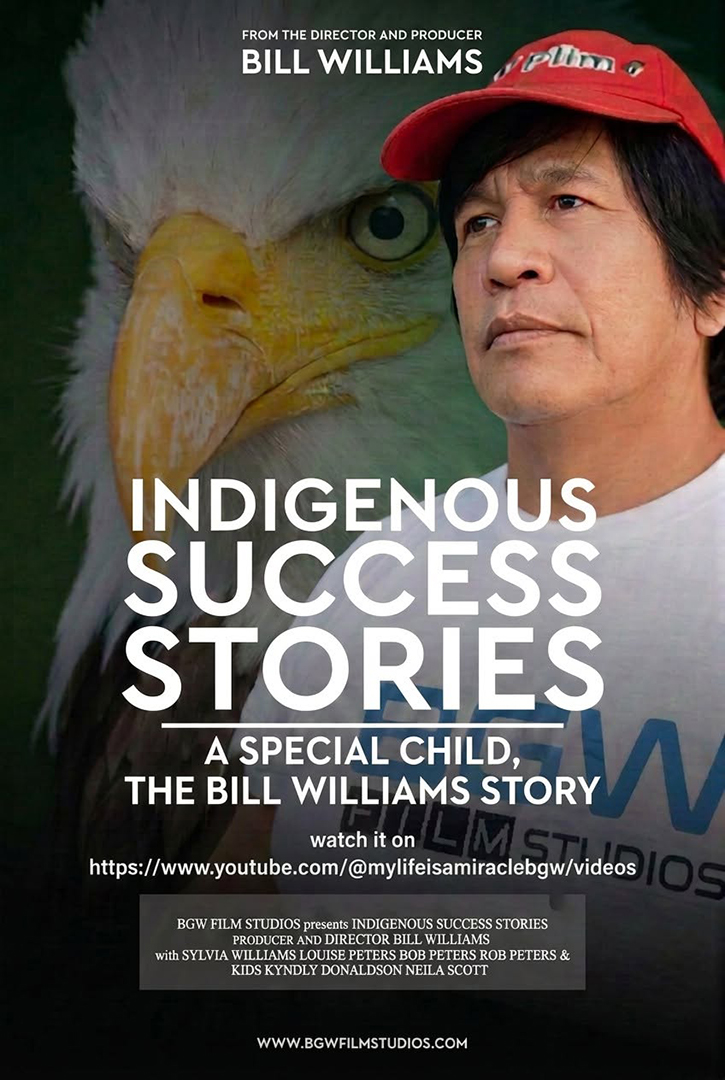
When he’s not on the streets helping people, or advocating for First Nations people in courtrooms, Bill writes and makes short films. He says he is the CEO of BGW Film Studios.
“I created the Indigenous Success Stories Franchise because, as a documentarian, I know our people are defined by resilience, not only by trauma,” he said.
Bill tells his story in Indigenous Success Stories – A Special Child: The Bill Williams Story, and in his song My Life Is a Miracle.
“I carry the scars of the shoebox, the handcuffs, and the mountain, but I no longer carry the fear. I share my story so that you know no matter how dark your valley is, you are not broken, you are not discarded, and your story is far from finished,” said Bill. “Where you start does not determine where you finish – I am living proof of that.”


