
January 2026 marks the 30th year that I’ve worked at Ha-Shilth-Sa Newspaper. I applied for the job in the summer of 1995, hoping that I would get the chance to work with the legendary Ha-Shilth-Sa Bob.
Popular, friendly and easy-going Bob Soderlund had already been working for the paper more than 20 years when I was hired. Annie Watts, his assistant, helped me navigate policy and procedures at the NTC.
My first day as a reporter for Ha-Shilth-Sa Newspaper was January 15, 1996. My kids were 13 and 14 at the time and I was in my early 30s.
It was near the start of the B.C. treaty process for Nuu-chah-nulth-aht and leaders at the time wanted to ensure that treaty news made it out to their people. At that time there was no internet and people relied on the Ha-Shilth-Sa Newspaper to get their local news.
The decision was made to hire two more reporters to cover treaty and community news in all three of the Nuu-chah-nulth Tribal Council’s regions.
I was hired as the Central Region reporter. Ahousaht, Hesquiaht, Tla-o-qui-aht, Toquaht and Ucluelet were in my region, and my office was based in Tofino.
When I reported to work that first day, I noticed that Bob Soderlund’s office at the NTC building was big. The double office was connected to a smaller office where Annie worked.
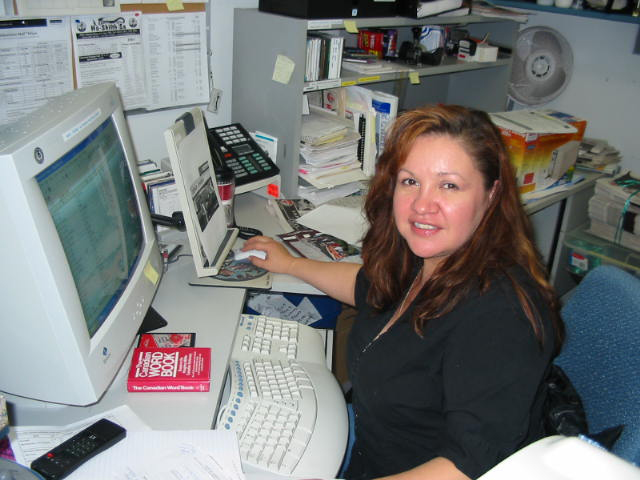
Bob’s office had a large drafting table pushed up against one wall. There was a mid-‘90s hulk of a computer on the desk and a darkroom in the corner. The rest of the large office space was taken up by filing cabinets stuffed with more than 20 years of back issues of Ha-Shilth-Sa Newspapers and boxes of unsorted photographs.
Bob, famous for his beautiful photography, used a Pentax K-1000 35mm film camera and processed his own photo prints in the darkroom.
He gave me a quick lesson on how to use the fully manual camera. I learned how to load and unload the film cartridges. My vision was perfect back then so focusing the camera wasn’t too difficult. I can’t imagine doing that today.
But those first months of using that camera were hard, especially when you’re trying to impress a seasoned photographer.
After you shot a roll of film, you brought it to the old mall for processing. It took up to a week to know if you had any salvageable images for your story. Hundreds of photographs were produced each month. The process was expensive and took a lot of space. This is why there were very few photos with those early stories.
I remember being sent to Victoria for a cultural event that first year. It was in the Mungo Martin building at the Royal B.C. Museum. I snapped several shots of the cultural activities that day. Something about that day made me feel like I would get some amazing shots for the story. It just felt right. Then I went home, opened my camera and discovered that I forgot to put the film in. Very embarrassing!
That was the first big mistake. There were plenty more over the next 30 years. Like the time I woke up late for a big meeting scheduled for a Saturday. I tried to sneak in through a side door but ran right into my boss. I decided honesty was the best policy and told him why I was late. He smirked, told me my story was amusing and then informed me that I wasn’t even supposed to be at the meeting that day.
As I lived in the Alberni Valley, commuting the Tofino highway twice daily for 14 years meant that I knew every crack, pothole and passing lane, and I made use of the passing lanes all the time. There was a time when one of the Ha’wiih was an RCMP officer. He happened to be patrolling the highway while I was on my way home from work.
He was doing the speed limit when I caught up to him. Calling upon every ounce of patience I had within me, I slowed down and waited for a passing lane. I passed him at the first opportunity and tried to gain distance when he couldn’t see me. But he knew what I was up to and pulled me over. I was hoping he’d cut me some slack, being Nuu-chah-nulth and all, but he was an equal opportunity warning-giver.
During the ‘90s our film cartridges were developed and made into prints at Port Alberni. Before we had internet and email, stories had to be saved on floppy discs and driven to the editor’s office in Port Alberni. There was a lot of traveling back then.
When it came time to layout the paper, Bob Soderlund was old school. Using scissors, he literally cut text from printed pages and glued them onto the story boards. The process took time and intense concentration, so Bob would do it after hours. He worked into wee hours of the morning, literally cutting and pasting the newspaper together before driving the story boards to the printer at the Alberni Valley Times.
After Bob retired, the darkroom was torn down to make more space, and the drafting table was disposed of.
Each new editor brought better technology. By the year 2000 we were using computer programs to layout the paper digitally. We moved to filing stories via email, and in the early 2000s we were introduced to digital photography. We now have a Ha-Shilth-Sa website where stories are posted most days, but we maintain a print copy because the people like it.
Those boxes of printed photographs and digital images, more than 10,000 of them, were sent out to be digitized and are now accessible online to the public via our Flickr account.
Along with advances in technology, I’ve seen huge growth in the use of Nuu-chah-nulth words over the past 30 years. With little exposure to the language, saying the words ‘Nuu-chah-nulth’ and ‘Ha-Shilth-Sa’ were intimidating to me in the ‘90s. I don’t even think about it when I say those words today.
Language revitalization became a priority for Nuu-chah-nulth-aht. With more people speaking and writing the language, I’ve been able to passively pick up words and phrases over the years, learning as I’m going along.
While I never expected to make a career of writing, it has been very satisfying and has sparked a love for learning history. I’ve spoken to hundreds of elders who have enriched my knowledge of Nuu-chah-nulth history. And I’ve done my best to share their stories from a Nuu-chah-nulth perspective – something that was rare at the time in local history books.
Looking forward, we have so many of our people graduating high school, attending colleges and universities. We can be sure that some of them will carry on telling our stories.