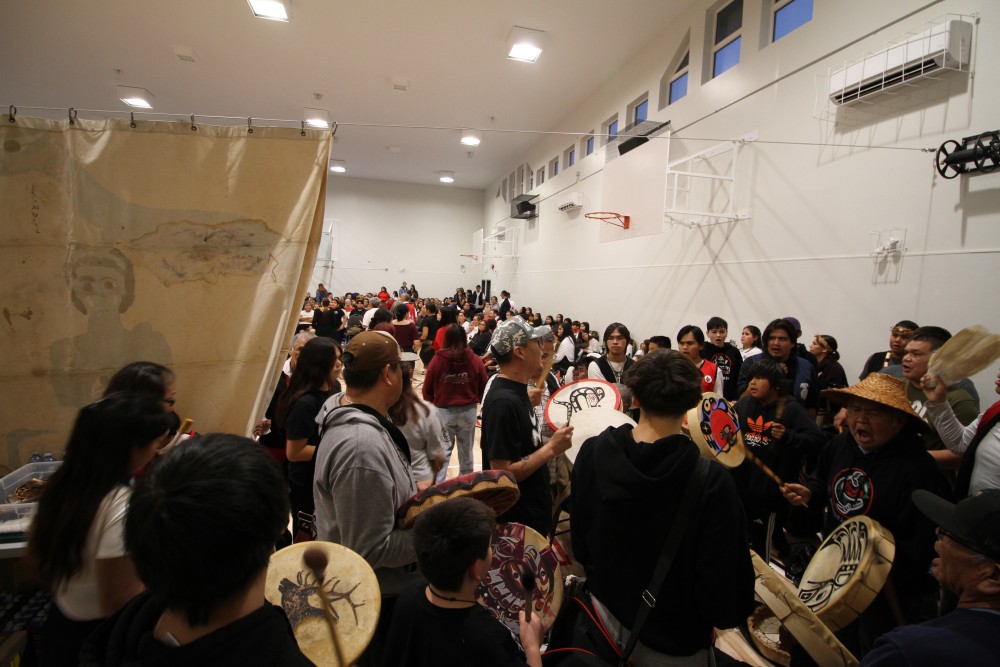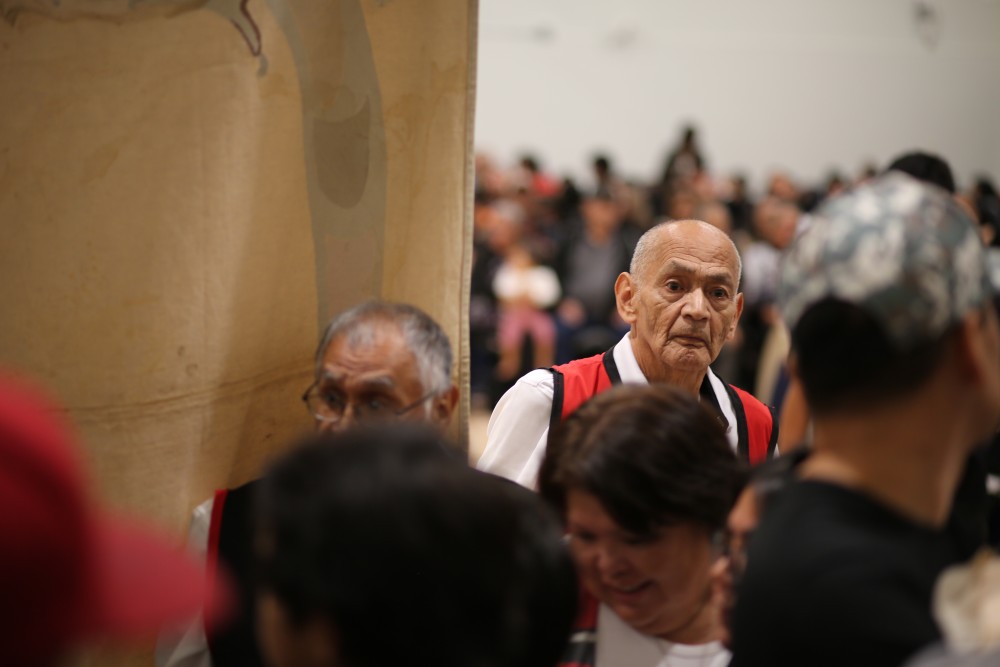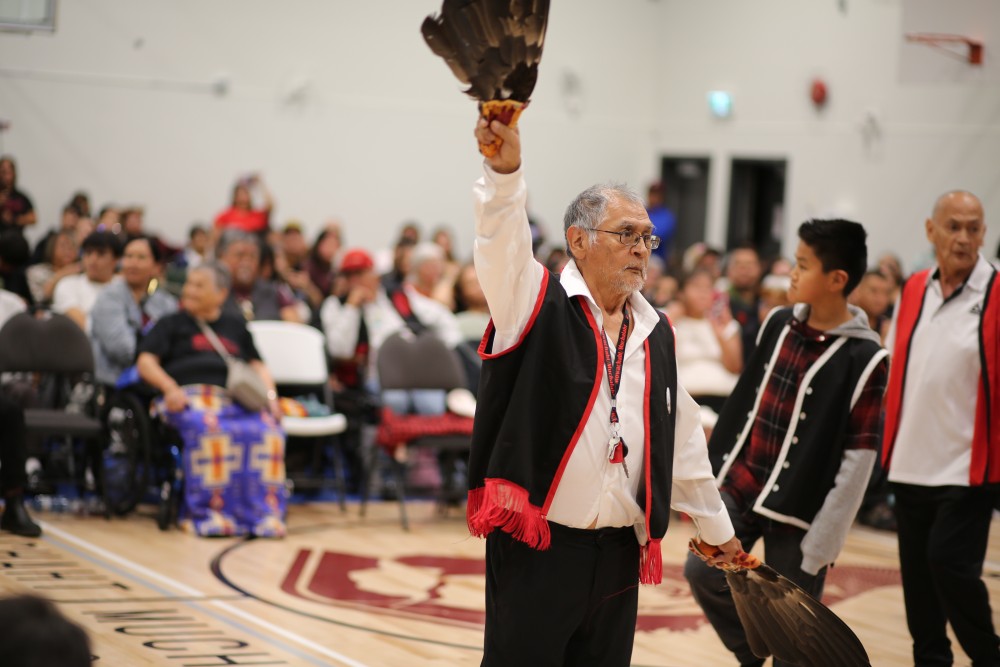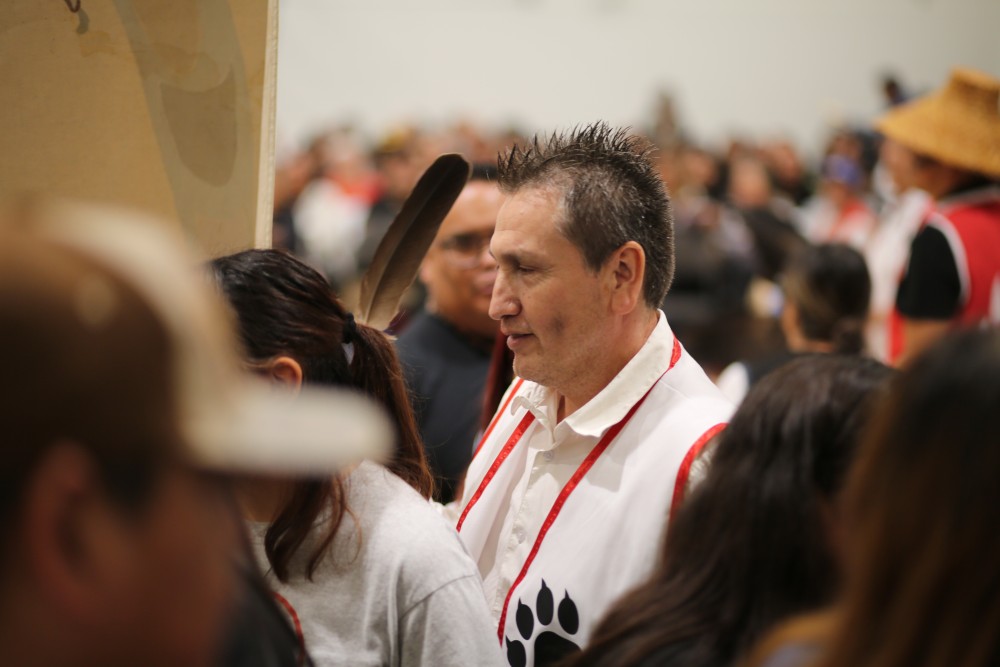
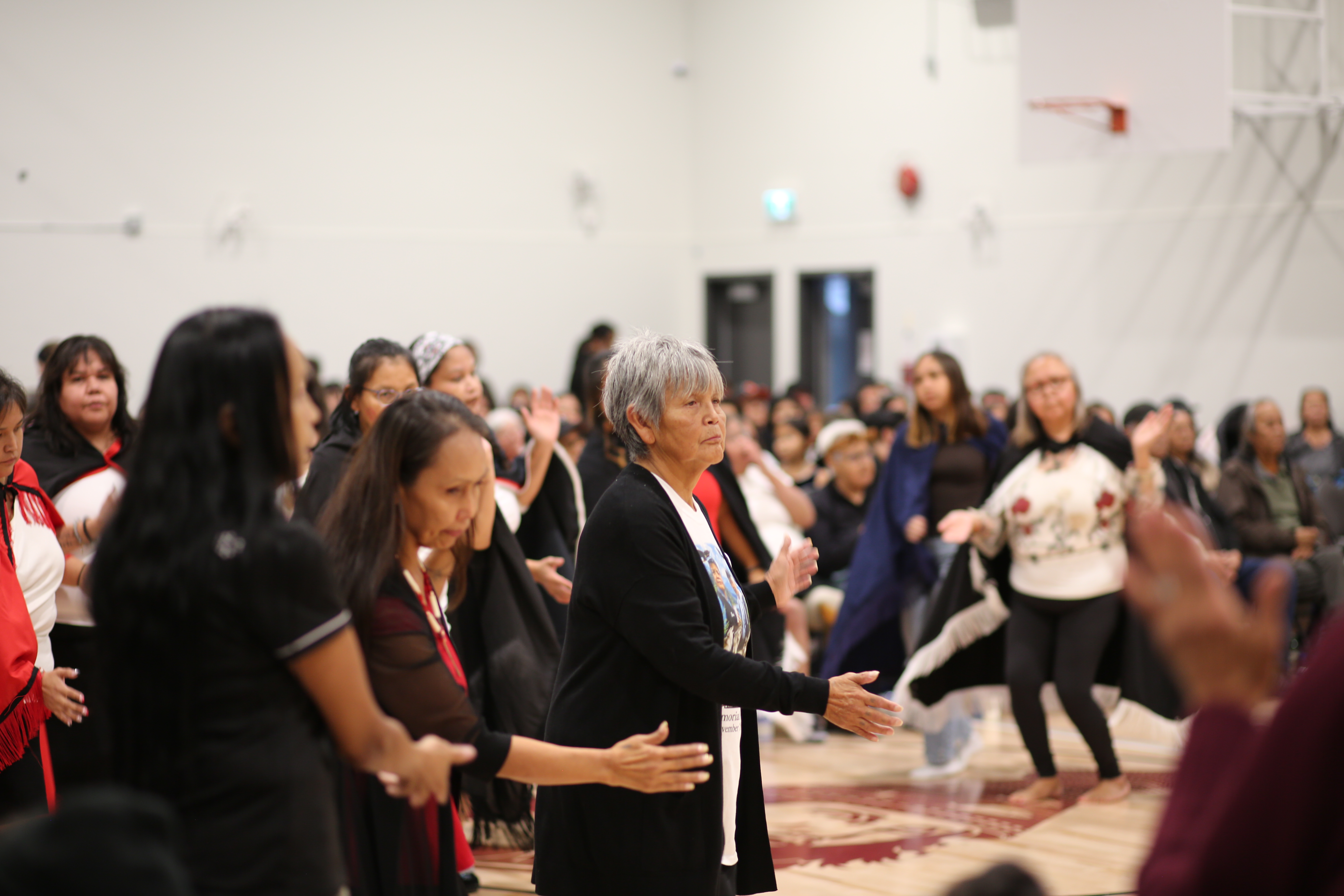
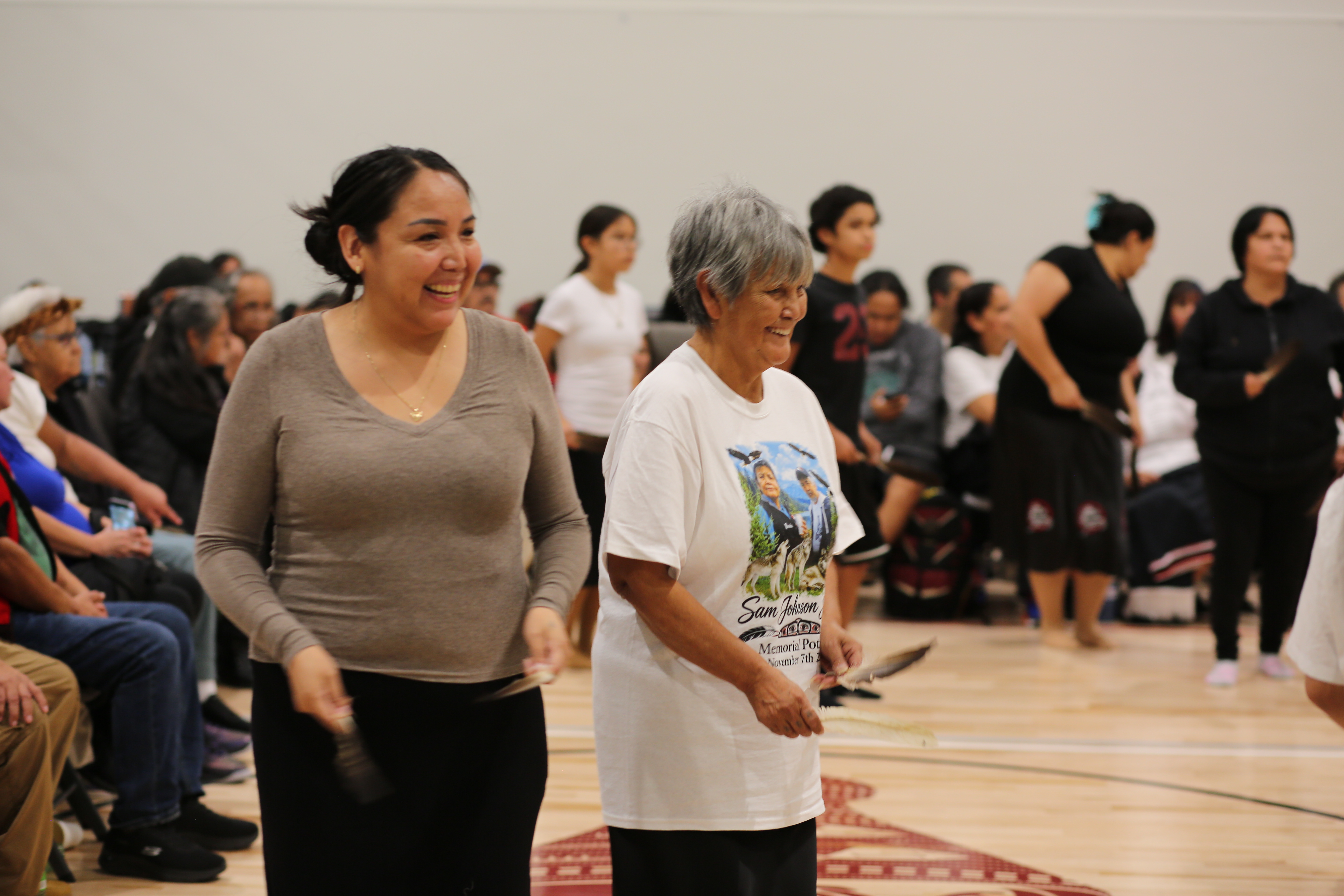
During the early stages of a traditional-style potlatch that would run all day, night and into the next morning, the family members of Samuel Johnson Jr. circled before a crowd of hundreds that packed the Tsaxana gym. As others drummed and sang, they turned over framed pictures they had been clutching against their chests, holding the portraits high for all to see the quiet smile of a loved one lost a year ago.
Following a Nuu-chah-nulth cultural tradition, it had been a year since family had seen an image of Sammy, or even heard his name. Other male and female relatives with the name Sam even switched to a middle name during this latent, pre-potlatch period.
For those who knew him well, the uncovering of the smile in those pictures opened a rush of emotions.
“He was a very special man to our family,” said Sammy’s wife Brenda to those in attendance, alluding to her husband’s love of such cultural events. “He brought happiness to the floor.”
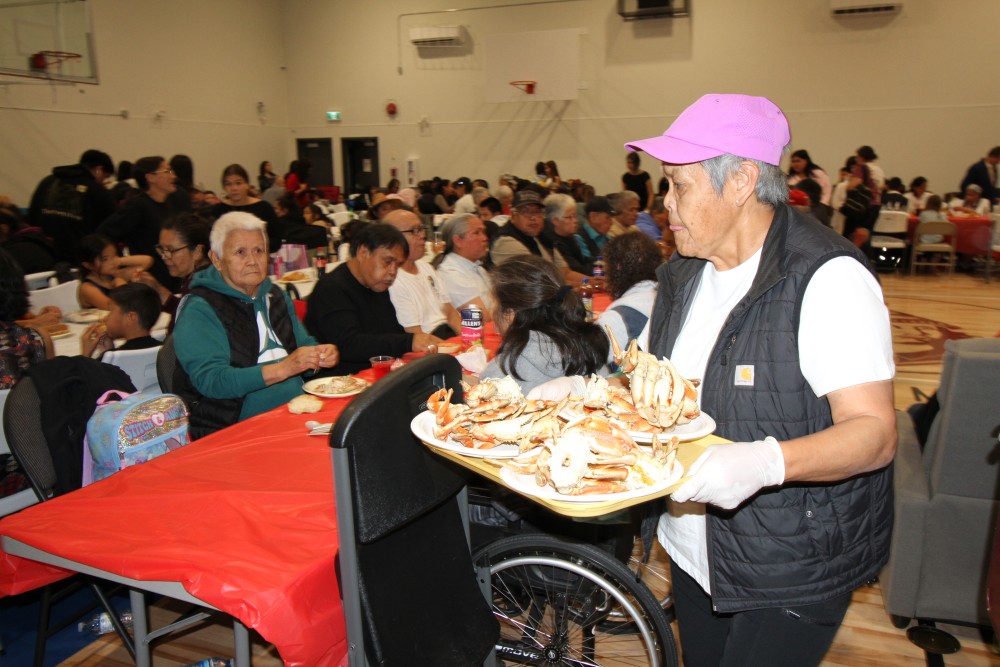
The “Drying of the Tears” potlatch began on Saturday, Nov. 7. As a November storm threatened to cut off the power as it already had in other parts of Vancouver Island, the event was held in the Tsaxana gymnasium, packed wall-to-wall with people on the Mowachaht/Muchalaht First Nation’s main reserve just outside of Gold River.
Bringing together Nuu-chah-nulth-aht from across the B.C. coast as well as many others who knew Samuel Johnson, the potlatch celebrated a life that ended on Sept. 27, 2025. Sammy was 71 and passed due to heart complications in the Campbell River hospital, a death that came as a surprise to many.
Sammy’s nephew Wayne Hinchcliffe had just spoken to him on the phone a day or two before, joking that he was going to take his uncle out of the hospital for a good time.
“I told him, ‘I’ll break you out of there and we’ll go to the casino’,” said Wayne.
“Sammy was a big part of my life. He took me under his wing. I’m not the only one. A lot of us he looked after,” he continued. “He used to always tell me, ‘If anything ever happens to me, look after my boys’. He used to call his grandchildren his boys.”
Struggling to hold back tears, Wayne said he took these words to heart, and lives on looking out for his nephews and nieces. Part of this entails teaching them how to fish and hunt, things that Sammy first taught Wayne when they lived at Ahaminaquus, a Mowchaht/Muchalaht reserve at the end of Muchalaht Inlet that the First Nation moved from in the mid 1990s.
“By seeing animals it always reminds me of him,” said Wayne, who still pictures his uncle sitting in the passenger seat of his truck, eagerly looking for elk or deer. “He was like a little boy, excited.”
Just one year younger than Sammy, Dale Frame knew him since he was 13. At that time Sammy arrived at the Gold River high school with others who had attended the Alberni Indian Residential School.
Frame recalls that these youngsters didn’t have the same academic grounding as others in the high school.
“When he come to this school, they just pushed them through,” reflected Dale of the Indigenous students’ time in the high school.
Although they came from different backgrounds, the two soon became close friends, playing sports during their youth and eventually hunting. Dale involved Sammy in his cougar tracking excursions, and even gave Johnson Jr. blue tick hounds he acquired from Montana to train.
“Sam didn’t have much money. We were selling the dogs for $500 a pup. I just gave him two pups to get him started,” Dale recalled. “Then I went through the process of teaching him how to hunt cats, because my older relatives taught me how to hunt.”
His old friend admits that Sammy was uneasy about getting under a cougar if the dogs had chased it up a tree, something that was necessary to get it to come down. But Sammy had a knack for catching signs in the forest.
“He was an exceptional tracker. A sign that I would walk by and miss, he would pick up on,” said Dale. “I learned a lot that way from him. He had patience too. He had a lot of patience with stuff.”
As both men raised their own families, Dale moved away from Gold River for 20 years to live in the Comox Valley. He kept in touch with Sammy and his family, and the two maintained a mutual understanding despite the difference of their cultural backgrounds.
“I never questioned what they did or how they did it. It’s their culture, they do what they do and I do what I do, and me and Sammy respected that,” said Dale. “If Sam Johnson was there, I had the time for him and he was going with us if we were going somewhere - and he wanted to come.”
Early childhood in Yuquot
Before starting at the residential school in the early 1960s, Sammy and his siblings spent the early part of their youth in Yuquot, an ancient Mowachaht village at the southern end of Nootka Island. In the ‘50s and ‘60s Yuquot was still the First Nation’s main on-reserve community before they relocated to Ahaminaquus.
Sammy’s younger sibling James remembers community gatherings in the basement of Yuquot’s Catholic church.
“He was my brother,” said James. “I missed him, I loved him.”
In preparation for the potlatch, Wayne Hinchcliffe engaged in the cultural practice of oosimch, cold-water purification in the nearby Antler Lake. As the event approached, his uncle’s presence became stronger.
“I’m going to miss Sammy, but he’s still part of me no matter what I do,” said Wayne.
“When you got to know him he had a dry sense of humour,” added Dale. “Sammy liked to tease, he was a teaser.”
“I still talk to him every day,” reflected Wayne. “Before my feet hits the floor I say good morning to the Creator, my grandmother and Sammy and all the relatives we’ve lost. That’s how I start my days.”