
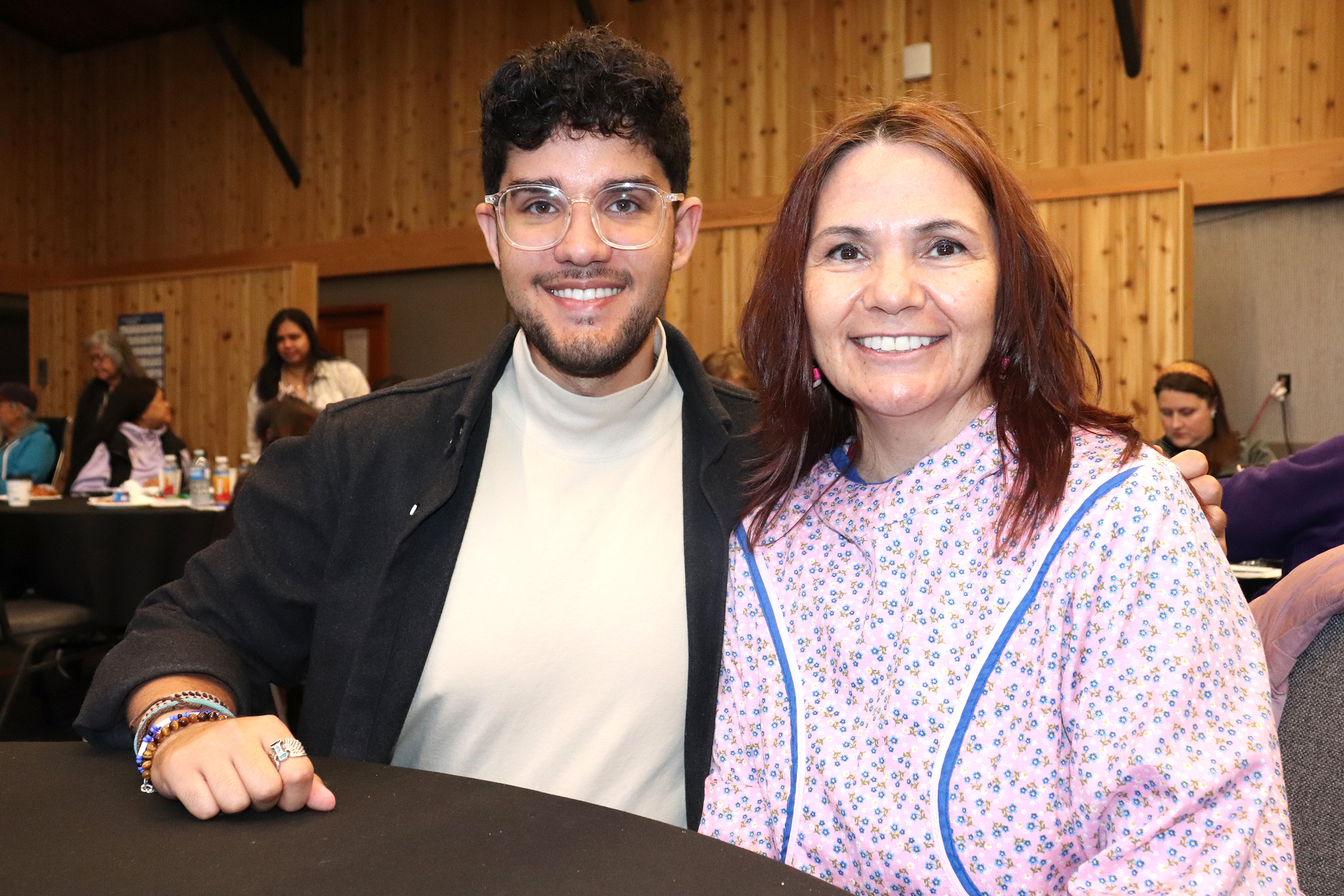
Can AI technology be used to safely revitalize Indigenous languages? What danger does AI pose to the storage and dissemination of Indigenous languages? These are questions explored by Professor Natasha Ita MacDonald and Ali Mehdi who presented at the Tla-o-qui-aht-hosted language conference held September 26-27 at Tin Wis Resort.
Dr. Natasha Ita MacDonald is an Inuk from Kuujjuaraapik , Nunavik. She completed her PhD at Concordia University with her research on Inuit-led approaches to decolonizing education and protecting Inuktitut language. She contributes to Indigenous language maintenance and revitalization as Vice-President of Heritage Lab, a non-profit supporting community-led cultural and linguistic preservation through AI.
According to the Heritage Lab website, it began from a shared commitment to supporting and strengthening Inuktitut in Nunavik through innovative, community-driven language technologies. “Today, that work has grown into a broader commitment: helping Indigenous communities access, govern, and shape language technologies on their own terms,” they stated.
Through Heritage Lab, language learning tools for Indigenous communities are being developed.
In Nunavik, most people still use the language, said MacDonald, however, in recent times it is in rapid decline. MacDonald works on protecting what they have and helping it to grow strong again.
The reason the Inuk language is in decline is because of how communication is done today. “The world – doctors, educators, public signs and everything on the Internet for Canadians is English (or French) speaking, so, younger people still must learn English, or French if you’re in Quebec,” said MacDonald.
“We are the drivers of determining how our culture and languages will survive. We don’t need to change for them. We’ve survived this long. We stay who we are, and we find a way that works for us. We work together,” MacDonald told the crowd.
Ali Mehdi has been working in Nunavik on computer technology and education. Heritage Lab has been building tools like games, books and language learning technology like Digital Voices which allows the user to hear Inuk words and phrases.
Developed with the help of fluent speakers, Digital Voices allows the learner to hear the language. Ali said that six fluent speakers, or voice actors recorded audio - Inuk stories and words. Through the program, children can follow along listening to digitized voices speaking Inuk.
The voice actors delivered 35,000 voice samples which were entered into computer programs. The system then builds sentences using digitized copies of the voice sound clips made by the voice actors.
It is like TTS (Text to speech) technology. Sound profiles saved in the system are used to generate audio speech for written words and sentences. ‘Write, scan, translate’ technology is helping educators develop language tools.
But the system uses AI (Artificial Intelligence) technology and there is a fear that the language may be somehow exploited. According to MacDonald, both the US Military and the Chinese governments ‘have politely asked to use our data bases’. Tech giant representatives from Microsoft and Meta have also offered to help develop the technology. This, she says, raises alarm bells.
“The Arctic is valuable on the global stage and for some reason, access to Indigenous languages is important to world leaders,” MacDonald noted.
To protect the data, Heritage Lab uses what they call closed loop AI. When we hear about data centres we think of massive buildings. The AI used by Heritage Lab is small. “It does not have access to places on the Internet that may seek to exploit it. It’s a small AI system that fits in a brief case that can only be accessed by authorized users. Data is kept in the community. It is encrypted so that it cannot be stolen in its entirety. It is also protected by levels of access. Very few have full access to the stored information,” said MacDonald.
The technology allows users and teachers to develop language tools like story books. It can potentially be used to create a dictionary where you can type in a word in English, for example, and the program plays a digitized audio recording saying the word in Inuk, along with the Inuk spelling of the word.
Heritage Lab is a non-profit organization that offers its technology tools to Indigenous communities to save languages.
“Ultimately, it is up to the customer to decide their level of security. They may choose not to allow their data on the Internet at all, but to successfully revitalize languages, children and youth need access to it,” said MacDonald.
“We believe in upscaling youth. They learn the technology, making them managers of your language revitalization in good paying jobs,” said MacDonald. And that includes the fluent voice actors, who get paid royalties for their recordings.
“Protect language and culture through AI…it’s not the scary stuff you’re hearing about. We’re doing it in safety,” said MacDonald.


