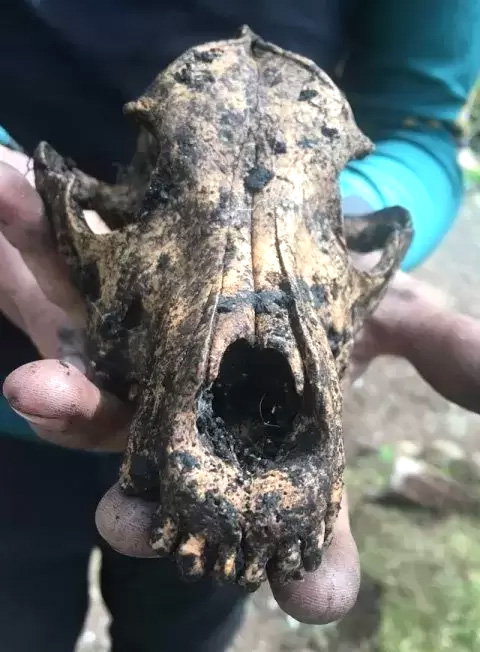
The news that a Woolly dog pelt is now on display at UBC’s Museum of Anthropology in Vancouver has drawn attention to the now extinct animal’s presence in pre-contact Nuu-chah-nulth villages.
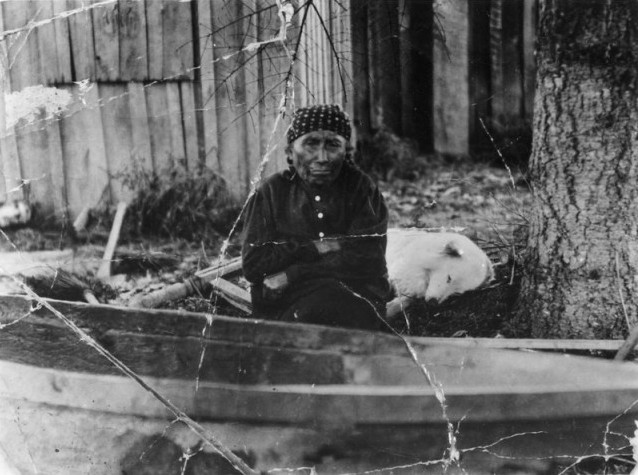
The Woolly dog was a small to medium-sized animal specially cared for and bred in pre-contact First Nations communities in what is now British Columbia’s Lower Mainland, the Pacific Northwest and Vancouver Island. Woolly dog bones have been found throughout Coast Salish and Makah territories, some dating as far back as 6,000 years according to a 2020 study published in the Journal of Archaeology.
Described as spitz-like dogs with curly tails, the Woolly dog was prized by coastal First Nations for its thick, double-coat, which was collected and spun, the yarn used in blankets and other woven items. In 1792 Captain George Vancouver of the British Royal Navy wrote, “The dogs belonging to this tribe of Indians were numerous and resembled those of Pomerania, though, in general, somewhat larger, they were all shorn as close to the skin as sheep are in England.”
Studies show that the Woolly dogs of the Pacific Northwest descend from ancient wolf populations with deeper genetic ties to early Asian and American log lineages.
The dog edged toward extinction at the time of colonization, and it is believed that the last known woolly dog died around 1940.
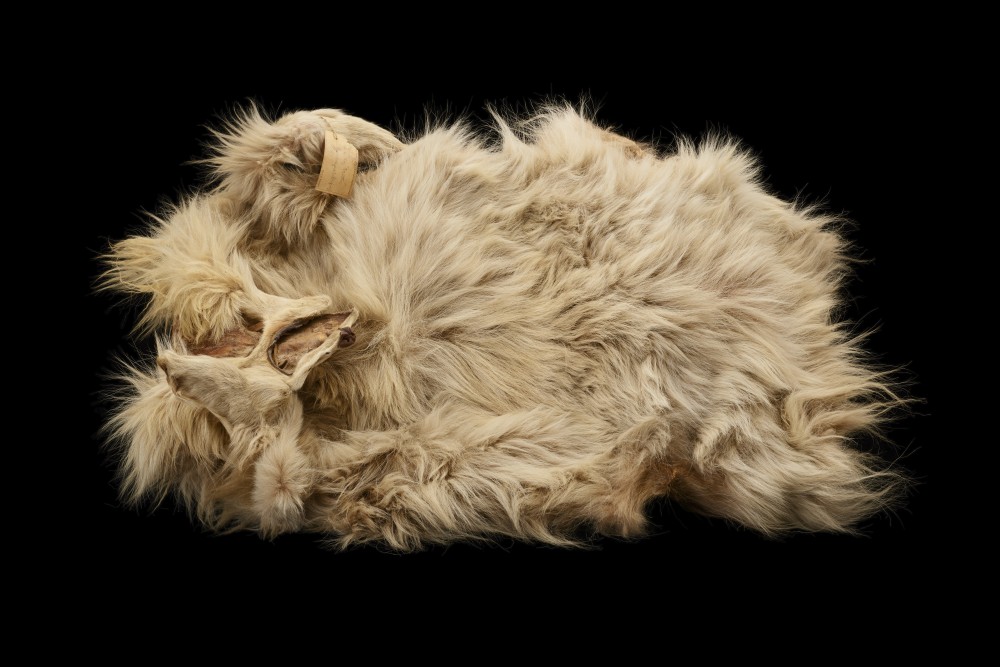
This month the Smithsonian Institute loaned the University of British Columbia’s Museum of Anthropology the only known Woolly dog pelt collected from B.C. in the mid-1800s. The dog, in life, was named Mutton and live near present-day Chilliwack.
According to the Canadian Encyclopedia, about 85 per cent of Mutton’s genome came from distinct pre-contact ancestry, proving it was a well-managed, pure breed developed long before European contact.
Few know that the Woolly dog was an important part of Nuu-chah-nulth communities. They were known to be bred by the Makah, located on the northwestern tip of Washington State. The Makah are close relatives of the Nuu-chah-nulth-aht on Vancouver Island, sharing the same language and whaling culture. So, it should not come as a surprise that the prized Woolly dogs would have made their way across the Juan de Fuca strait to Vancouver Island.
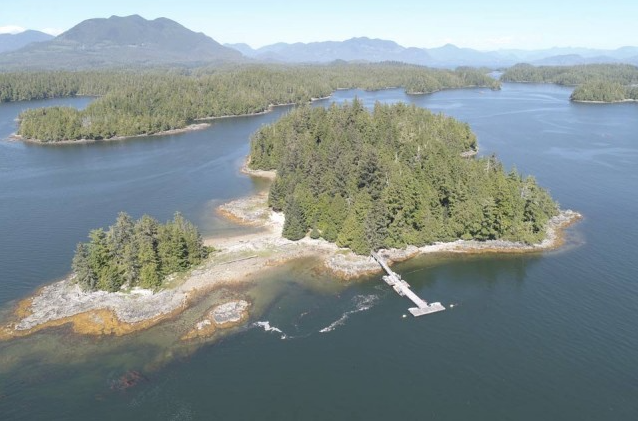
Archaeological digs in Barclay Sound have unearthed several sets of dog remains. According to Audrey T. Lin, research associate in the American Museum of Natural History’s Department of Mammalogy, ancient dog remains from Nuu-chah-nulth territories are being studied.
“One large dog was recovered from T’ukw’aa, which is part of Toquaht territory in Barkley Sound. It was purposefully buried close to whale bones,” she told Ha-Shilth-Sa.
It is inferred that the purposeful burial and its closeness to treasured whale bones indicates that the dog was important to the people who buried it.
The other two sets of dog remains found on the west coast of Vancouver Island are from Tseshaht territory in the Broken Group Islands.
“They were determined to be wool dogs by size, but I am hoping that with DNA we can actually confirm if they are Woolly dogs (or not),” said Lin.
According to Lin, bone measurements alone is not a definitive way of determining species.
“I'm doing genetic testing on the one ‘not a wool’ dog from T'ukw'aa, and two dogs, (‘wool dog’ and ‘possible wool dog’) from Keith Island. I am hoping to have some results by the year's end,” Lin wrote in an email.
An essay about the wool dog found on Keith Island was written by Katie Dierks in 2020, titled Osteobiography of an Ancient Nuu-chah-nulth Wool Dog: Investigating the Life and Death of a Domestic Dog from Tseshaht Territory in Barkley Sound. Dierks wrote the paper in partial fulfillment of the requirements of the Honours Program in the University of Victoria’s Department of Anthropology.
In her paper Dierks noted that the wool dogs found in archaeological sites in the territories of Nuu-chah-nulth First Nations on the west coast of Vancouver Island have received limited research attention.
The dog excavated from ancient shell midden deposits from Tseshaht territory in Barkley Sound, she wrote, offers potential insight on how these dogs were treated and the relationships they had with Nuu-chah-nulth peoples prior to European contact.
Early 19th century seamen observed that wool dogs in Makah villages were kept on isolated islands to prevent them from interbreeding with village dogs and losing their pure fur quality.
The Kakmakimilh dog, unearthed on Keith Island, Tseshaht territory, was determined to be a male adult, at least 18 months of age at the time of death.
It is apparent that the dog was buried with care.
“The remains were determined to be purposefully buried based on the articulation and anatomical positioning of skeletal elements, otherwise the bones would have been damaged or dispersed by scavengers if left exposed on the midden,” Dierks wrote.
She went to say that the remains of the dog were positioned in a roughly north-south orientation, with the head facing south.
“The positioning of the remains has the limbs tucked underneath the body,” she noted. “Associated with the burial were several intact paired clamshell valves as well as a hammerstone located directly underneath the left humerus. One large butter clam was nested in the ribcage of the dog. These paired clamshells located in the dog’s ribcage suggest they were purposefully placed into the burial rather than an accidental occurrence.”
The condition of the skeletal remains show that the dog had been injured in life and cared for until its injuries healed. There was a healed broken rib, an injury to the tail and signs of osteoarthritis in a knee. But the dog survived past its injuries, being fed and protected from predators. Scientists suggest this shows that this wool dog had a strong social bond with the people at Kakmakimilh.
There are two partial dog skeletons excavated from the Broken Group Islands that appear to be deliberate burials. These dog remains were located at a site that, according to researchers, indicates they were buried long before contact with Europeans.
“(The) dogs were located at the earliest dated portion of the site, which means Tseshaht kept dogs there as early as 5,000 years ago,” Dierks wrote.
Written descriptions of Nuu-chah-nulth wool dogs have described them as being large- or medium-sized with pointed ears and thick coats of white, brown, or black-colored fur. Early ethnographers noted that wool dogs in Nuu-chah-nulth territories were larger than the ones on the east coast of Vancouver Island in Coast Salish territories. One source claims to have been told of a large-sized wool dog from the village of Yuquot on the south edge of Nootka Island.
Another reference to wool dogs and Nuu-chah-nulth-aht comes from Dr. Nancy Turner, who wrote that the animal’s hair was often spun with yellow cedar bark in Nitinaht communities.
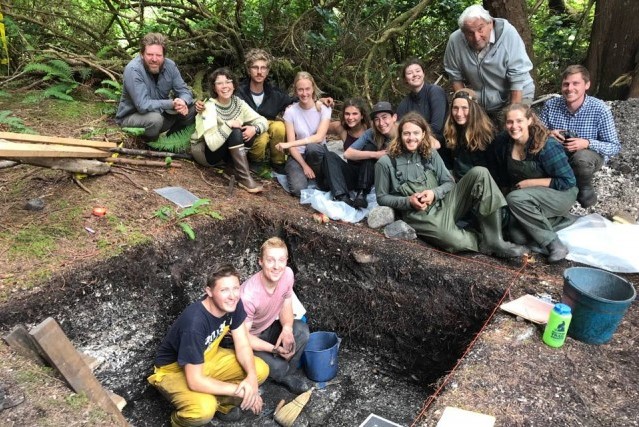
The Kakmakimilh Archaeological Project is a collaboration between Tseshaht First Nation, UVic’s Department of Anthropology, Pacific Rim National Park Reserve and the Bamfield Marine Sciences Centre.
Dr. Audrey Lin continues to pursue research with Nuu-chah-nulth communities on dogs, specifically from Toquaht and Tseshaht territories.