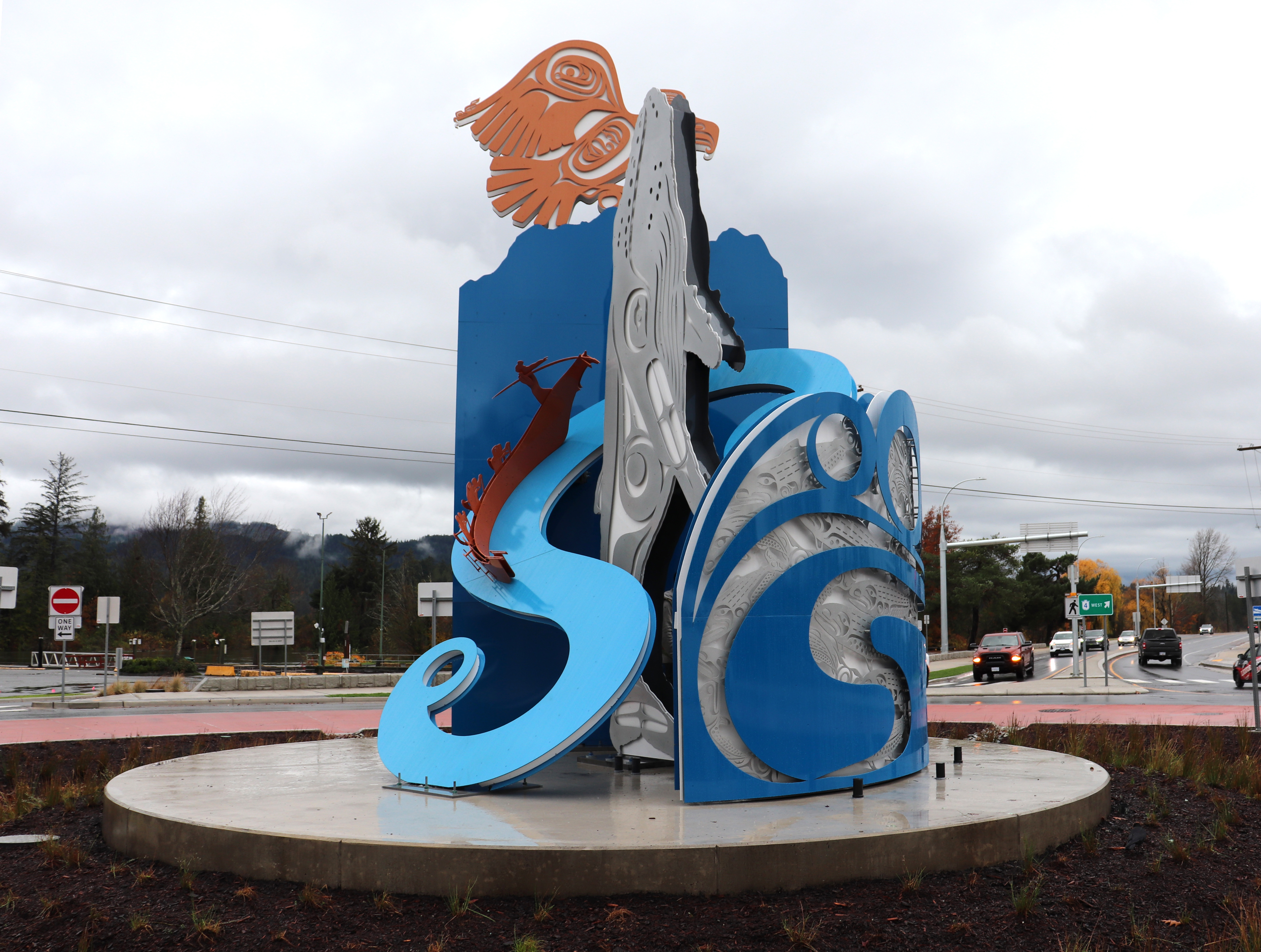
“Stunning, amazing, breath-taking…those are just a few of the words people are using to describe the newly installed sculpture created by Tseshaht artist Connie Watts. The new, multi-faceted work is installed at the Beaver Creek/River Road traffic circle which was completed in the summer of 2026.
Traffic approaching the new roundabout will have a colourful view of Watts’ interpretation of Tseshaht history and culture.
River Road and Beaver Creek Road was temporarily rerouted November 10 to allow for the safe installation of a beautiful art installation created by Tseshaht artist Connie Watts.
Titled ʔiqḥmuut̓asckʷi (from our deep past to today), the towering, multi-faceted sculpture features imagery of mountains, wolves, salmon, cedar forests and Nuu-chah-nulth whalers with a grey whale, all topped by the Thunderbird.
Watts noted how fitting it was that during the installation a few days earlier, a thunder and lightening storm rolled through the valley, like a nod to the new Thunderbird that now overlooks Clutesi Haven Marina.
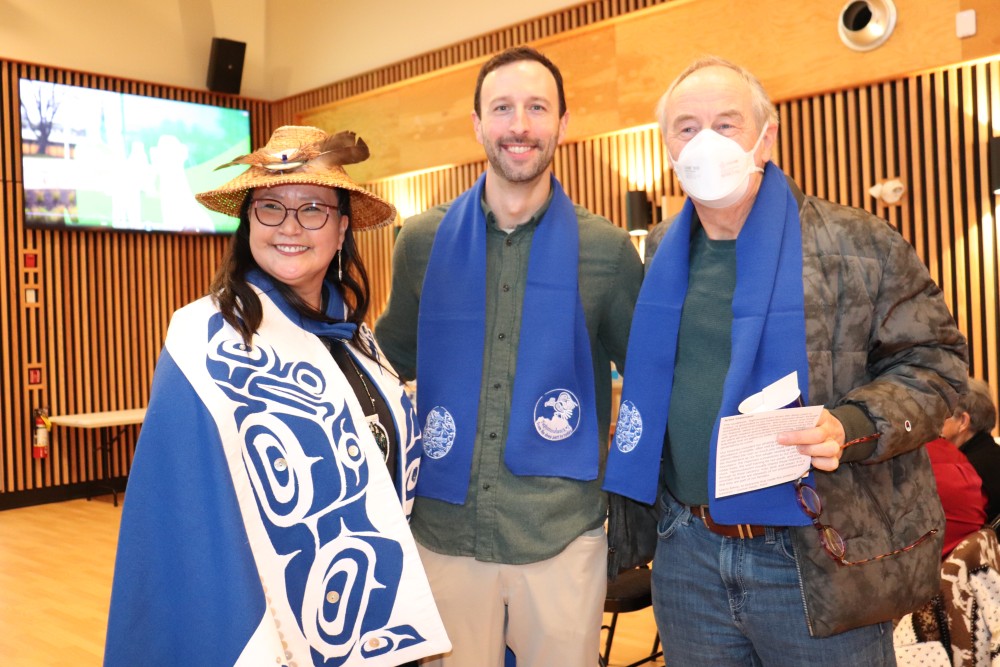
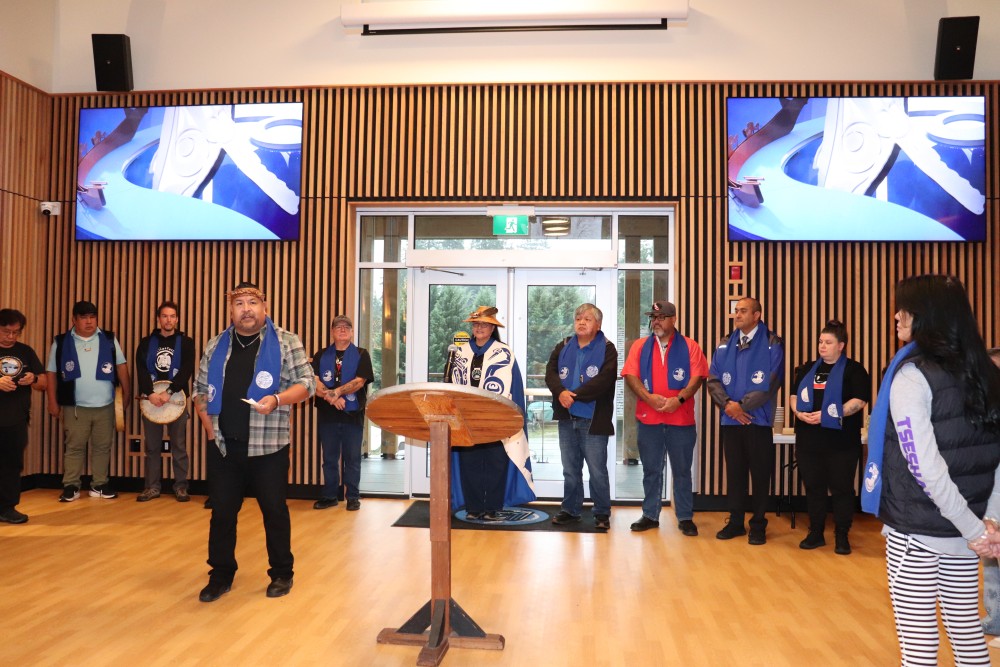
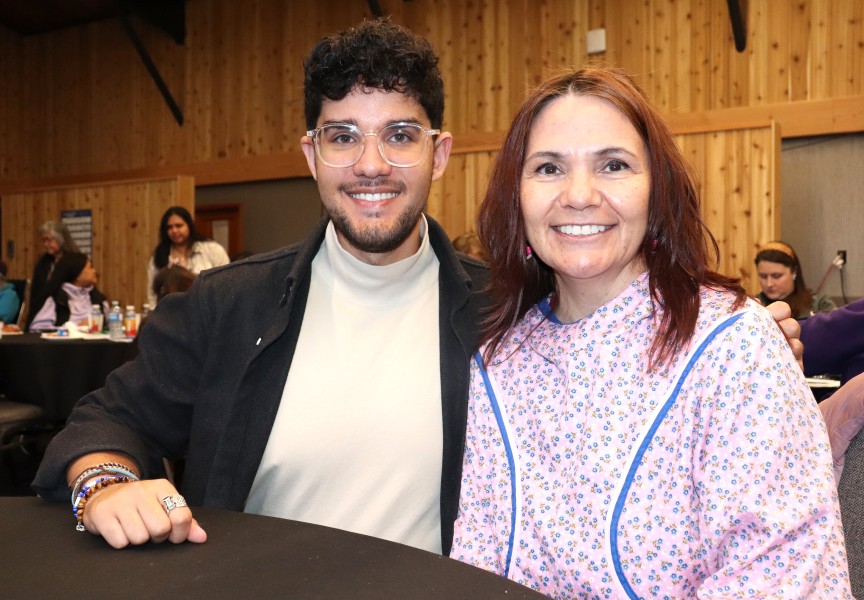
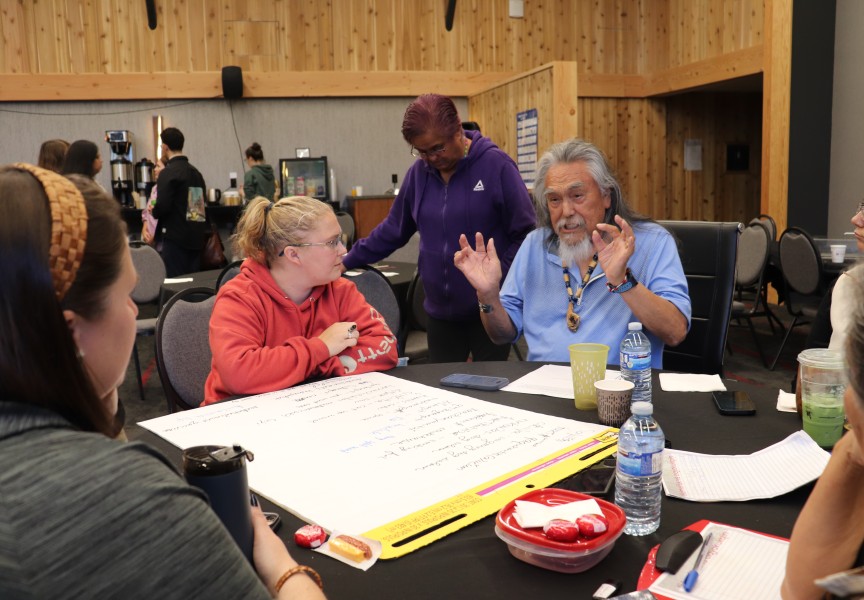
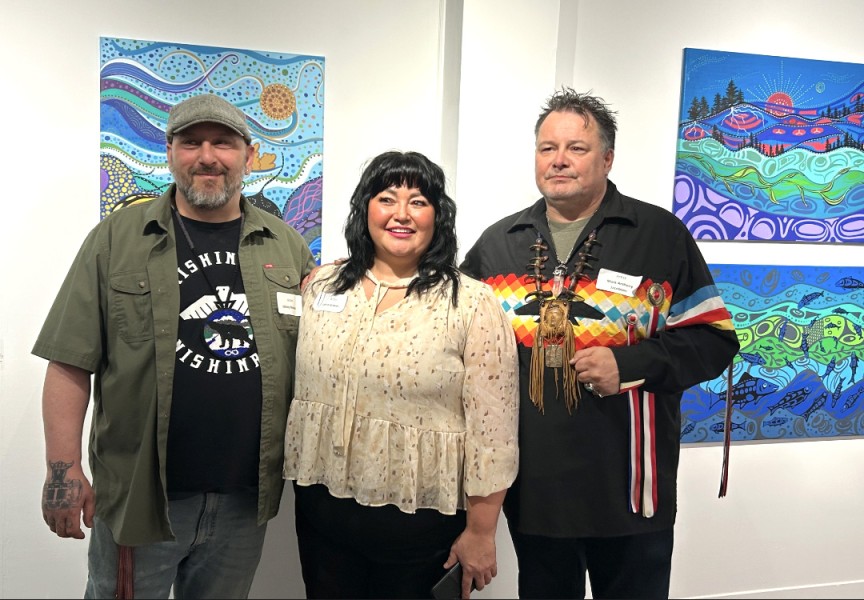
The community gathered at Tseshaht’s Somass Hall on November 13 to celebrate the installation of the stunning piece of art. The gathering was funded by the BC Ministry of Transportation & Transit, and brought together local First Nations leaders and officials from the City of Port Alberni, including newly elected Mayor Charles Mealy.
Following a warm Tseshaht welcome, Hupacasath elected Chief Brandy Lauder said the project showed what can happen when people come together in the spirt of cooperation. “I am pleased to have worked side-by-side with everyone on this project,” she told the crowd.
Acting Tseshaht Chief Les Sam said the Clutesi Haven Marina site has historical significance for the Tseshaht because it was a place where their canoes were landed. He said the art installation is a proud moment for Tseshaht First Nation. “We will have tourists coming to town, a food outlet at the marina and I’m proud to have Connie’s work there for everyone to enjoy…everybody is talking about it,” said Sam.
Both Chief Lauder and Mayor Mealey acknowledged former City of Port Alberni Mayor Sharie Minions for her work on the project. Lauder said all the leaders worked together with a desire to have people wanting to stop in Port Alberni, and to have something beautiful to look at.
The intersection at River Road, Beaver Creek and Clutesi Haven Marina has been troublesome for decades. Mayor Mealey recalled that the City of Port Alberni proposed installing traffic lights about twenty years ago. They proposed moving the traffic lights from Third Avenue and Napier Street to the Beaver Creek location, but that never happened.
The Ministry of Transportation, whose jurisdiction includes Highway 4, encompassed by River Road, replaced the intersection with an $8 million roundabout in 2026. The goal is to reduce congestion, enhance sight lines, support future traffic demands, and eliminate the need for left turns.
Multi-use paths, sidewalks and bike-friendly shoulders will make the intersection safer and more accessible for cyclists and pedestrians, the ministry states in a news release.
Chief Lauder said something needed to be done, adding she doesn’t miss waiting 20 minutes trying to enter the highway from Beaver Creek Road.
The new roundabout complements work being done at Clutesi Haven Marina which is being upgraded to attract tourists.
“Access to Clutesi Haven Marina will be improved through widened and reconfigured entrances. This will help reduce highway congestion and support commercial, Indigenous and recreational fishers,” states the Ministry of Transportation.
Finishing touches to the roundabout, including landscaping has just been completed. All that was needed was to add something to the center of the roundabout. Connie Watts, a world-renowned artist delivered on a stunning central piece of art that delivers beauty now matter which angle you approach it from, and it looks just as beautiful at night when its lights are on.
“The sculpture, ʔiqḥmuut̓asckʷi (from our deep past to today), is grounded in our histories, passed down through storytelling and oral traditions. We were never one thing; our nations were a complex cultural structure that lived with great respect and deep-rooted understanding that we are all one and connected to everything. These teachings live on within us today and will continue for generations to come,” Watts said in a statement.
She went on to speak of the elements of sculpture including wildlife, whaling and existing with what nature provides. “Our histories included our whaling practices; our abundance of wildlife, often told by the Elders that the salmon filled the river so much you could walk across it; the thunderbird as our first whaler nesting up on the mountains; the important connections to our old growth cedar trees; the wolf training for our youth and so much more,” she wrote.
Watt’s sculpture features scenes from the river and the ocean, the forest and the Thunderbird on the mountain top. The components are individual, but blended together – interconnected, with salmon swirling through the waves of the river, spilling into the ocean where the whaler meets the grey whale, with a forest filled with wolves, the mountain and thunderbird as a backdrop.
Watts thanked the team for helping complete the project and she thanked everyone for coming to celebrate. “I really appreciate it,” she said.
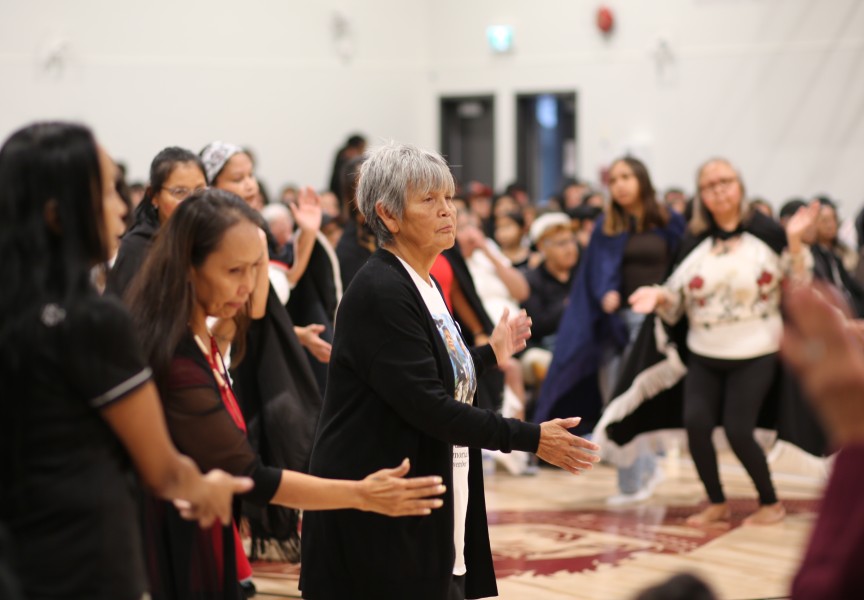
Ed Ross acknowledged the people that helped bring the project to completion, “lifting our town up,” he said. He called upon Tseshaht singers and dancers to perform their Tyee Ha’wilth’s song in honour of all the people that worked together to complete the project. “This is what can be achieved when we’re working together,” he said.