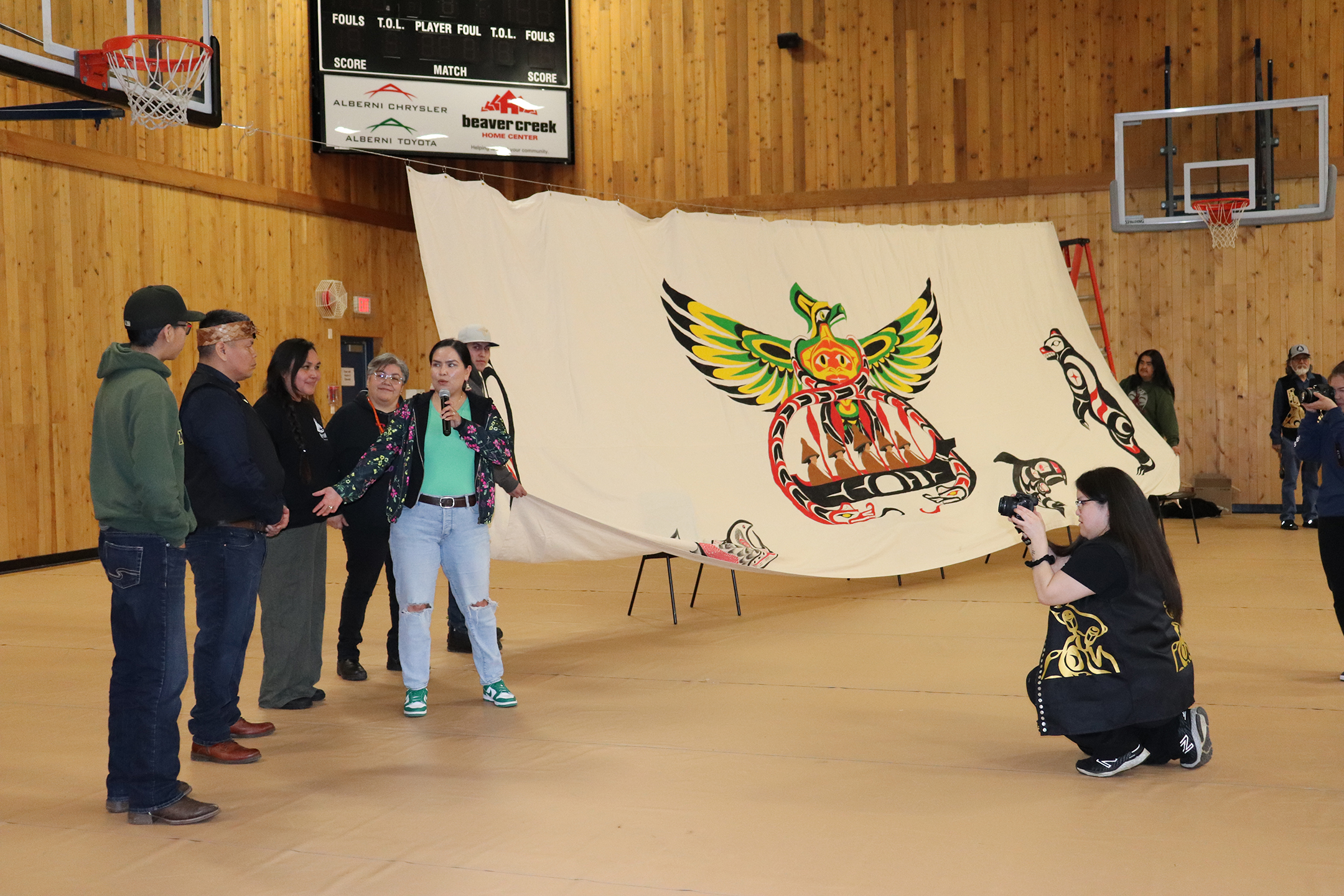
The five nations that fought the Canadian government for their Aboriginal right to harvest and sell fish, and won, gathered to celebrate on March 13, with the unveiling of their new ceremonial curtain.
The Ha’oom Fisheries Society (HFS), represented by the five Nuu-chah-nulth nations that participated in the landmark court case, the Ahousaht, Ehattesaht/Chinehkint, Mowachaht/Muchalaht, Hesquiaht and Tla-o-qui-aht First Nations, have been working together tirelessly to implement and manage their commercial rights-based fisheries.
It was in 2009 that the court ruled in favor of the Nuu-chah-nulth-aht in the BC Supreme Court case, Ahousaht et al. vs. Canada, which overturned decades of restrictive DFO policies that forced many Nuu-chah-nulth fishermen out of the commercial fishing industry.
Based in Tofino, HFS employs mostly Nuu-chah-nulth people who work to ensure that their constitutionally protected right to harvest and sell fish is managed in accordance with principals laid out by the Ha’wiih (hereditary Chiefs) and their advisors. The foremost principle for sustainable management is Hišuk ish tsa’walk (meaning everything is connected, everything is one).
“This (principle) includes implementing fisheries for the five nations based on their inherent and constitutionally protected Indigenous right to harvest and sell fish; enhancing the capacity and role of the five Nations in the management and sustainability of fisheries, in collaboration with the Fisheries and Oceans Canada where appropriate,” as stated on the HFS website.
The celebration started with dinner which included fresh herring eggs for an appetizer and a seafood buffet. Most, if not all of the seafood came from the HFS members.
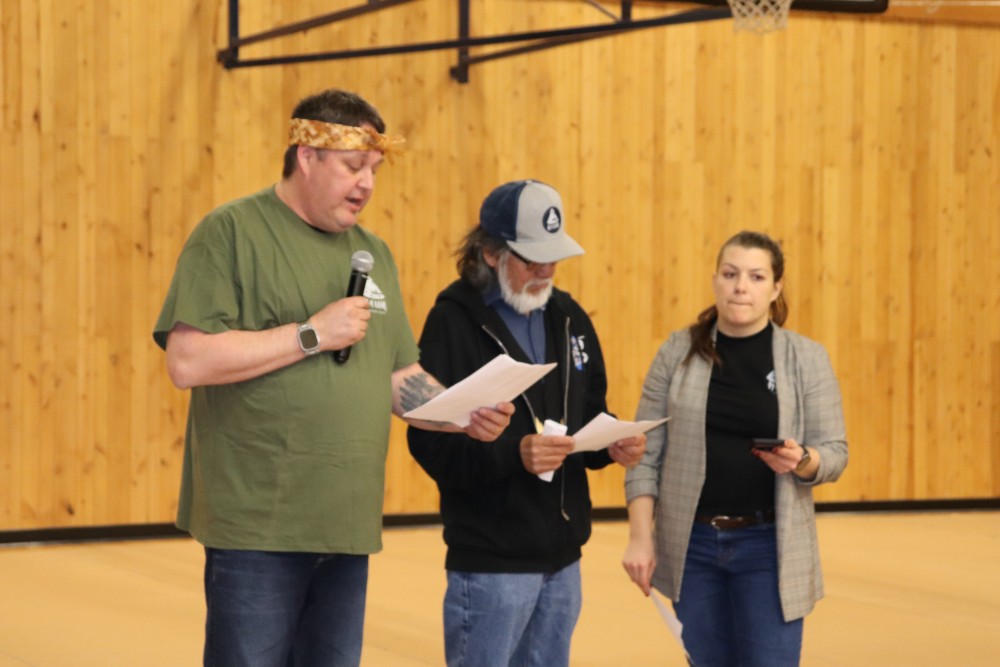
David Miller of Ehattesaht/Chinehkint, welcomed everyone, telling them that this would be a night for recognizing all the work that has been accomplished, and what is being planned for future generations. First nations enjoy through unity, he noted.
“For generations, our people have depended on the ocean,” Miller said, adding that the Nuu-chah-nulth not only harvested seafood, but also preserved it and traded it. It is not only a right, but a way of life, he added.
Since its establishment in 2021, HFS has been working to restore access to the fisheries and economic opportunities for their member nations. That includes training and mentorship for next generations of Nuu-chah-nulth fishermen.
In keeping with Nuu-chah-nulth teachings about sustainability and protecting the resources, HFS also conducts research and development with respect to rebuilding ocean resources
Following dinner, Ahousaht elder Cliff Atleo spoke at length about the history of the fisheries court case and Ahousaht’s position. “We didn’t want to go to court, but we knew what we had and we knew we were going to kick butt in court,” Atleo told the crowd.
“We want everyone to know that it (resources in Nuu-chah-nulth territories) belongs to our Ha’wiih (hereditary chiefs),” said Atleo.
Abigail Titian-Manson works for HFS as its Community and Capacity Building Coordinator. She said that HFS has had other gatherings where they would have to borrow ceremonial curtains from the Ha'wiih. Someone came up with the idea of making their own curtain, known as muyapiłum, that would represent all five nations.
It was decided that five artists, one from each nation, would work on the muyapiłum.
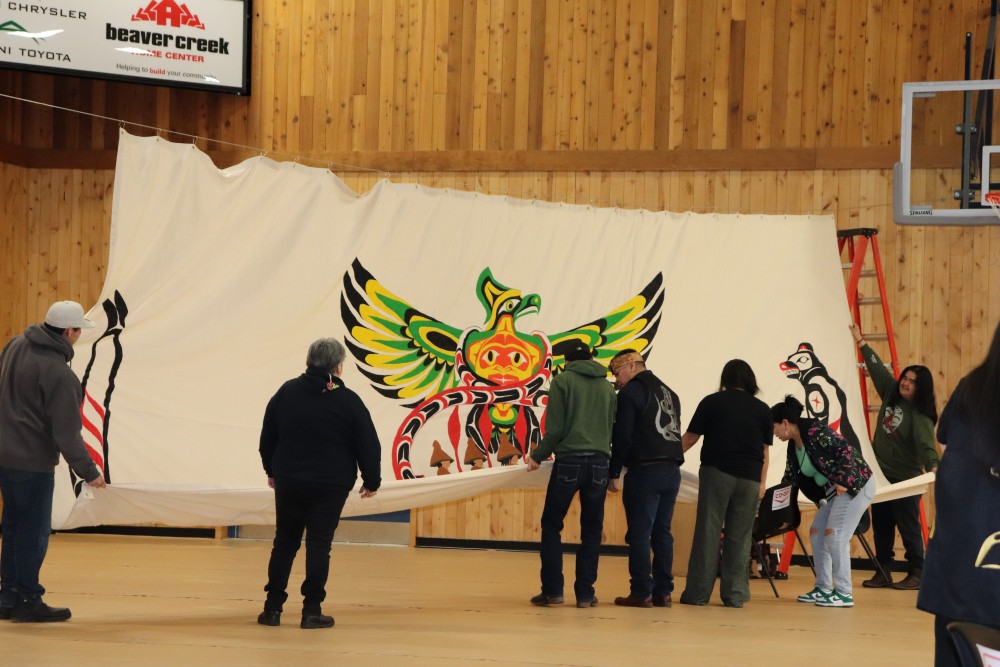
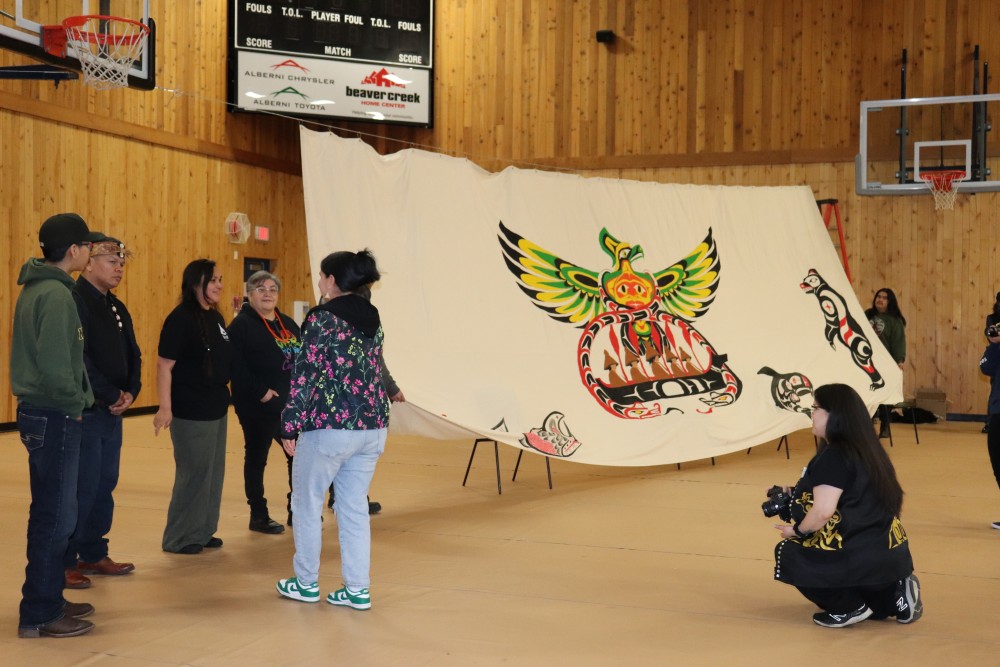
Also called a thliitsapilthim in other Nuu-chah-nulth language dialects, a ceremonial curtain is not simply a colourful display of Indigenous art. Its purpose is to tell a story through symbolism. For Ha’wiih, the curtain can describe what is in their territory, what they own, what powers they have and more.
Following dinner, the artists and helpers carefully unfurled the curtain. The artists, they said, were Geena Hayupis for Hesquiaht, Stan Bob, Lacey Adams, Bill Morris and Walter Thomas.
“Lots of work went into this curtain,” said Kayla Lucas. She said the artists consulted with other people to come up with an overall design of the curtain.
“They (artists) put their time, effort, heart, soul and passion into this,” said Lucas.
The curtain will be used at all future gatherings of HFS. The collaborative piece represents the critical importance of fisheries to the people of the five nations.