Now that the cause of the global destruction of sea stars has been discovered, researchers hope to rebuild the species to attain great ecological balance in Pacific waters.
“The team has identified the causative agent of sea star wasting disease, which is an epidemic that’s been ongoing for more than a decade now and has really impacted populations of sea stars in more than two dozen species,” said Melanie Prentice, a research scientist from the Hakai Institute and part of the research team. “So, we’re absolutely thrilled to be able to have an answer to this question.”
The microbial culprit responsible is a strain of the bacterium Vibrio pectenicida, from the same bacterial family that causes cholera in humans.
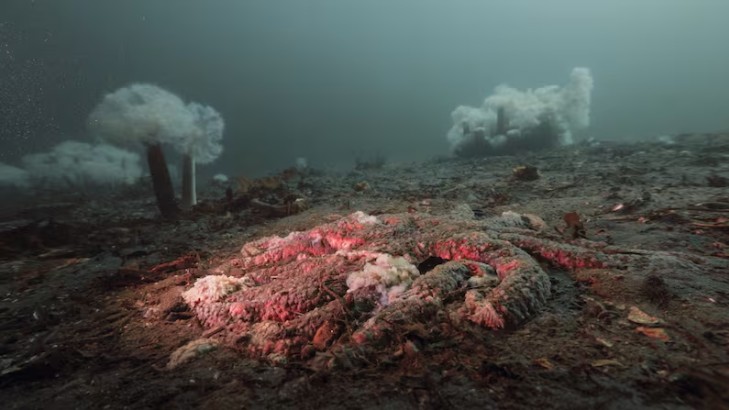
Once infected, sea stars twist their limbs to clean off white lesions that appear on their bodies and bore holes in their epidermis and muscles. Then, they lose their internal pressure and deflate. Unable to move or diffuse oxygen across their surfaces, the sea stars' arms fall off, and ultimately they melt into a white, goo-like paste.
SSWS came to attention in June 2013 in the first wave of mass mortalities along the Washington coast. The die-off trend continued in British Columbia, California, Mexico and Oregon.
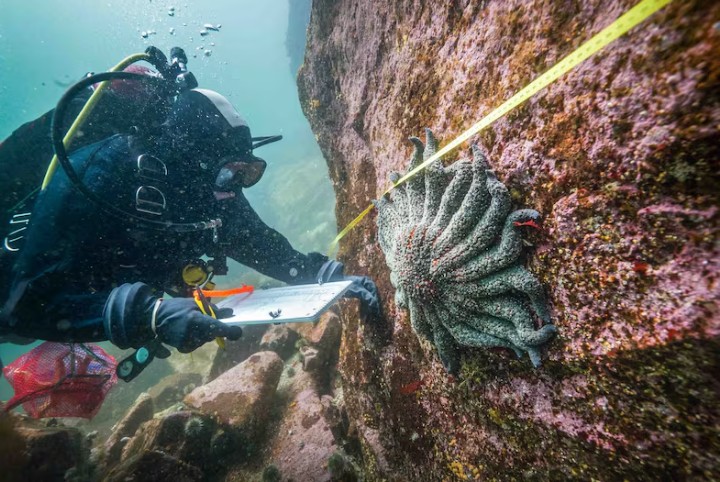
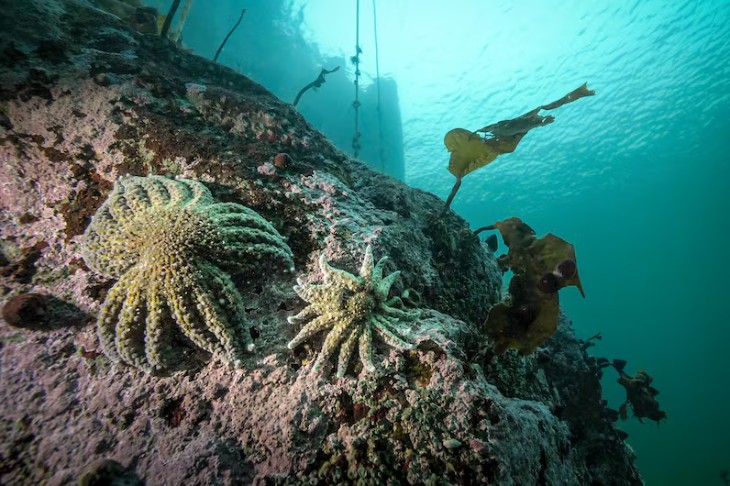
The sunflower sea star, the most affected by SSWS, lost 90 per cent of its global population, with 5.75 billion specimens dead. Since December 2020, the sunflower sea star has been listed as critically endangered by the International Union for Conservation of Nature.
A four-year international collaboration with the University of British Columbia, the University of Washington, the Hakai Institute and the Nature Conservancy was established to investigate the cause of the disease. The research paper was published in the journal Nature Ecology and Evolution.
Nailing the specifics that were causing the stars to “melt” was a challenge, as sea stars can respond to other stress factors like temperature changes, which present the same symptoms of twisted limbs or losing arms.
“Warmer weather temperatures have been related to disease outbreaks since 2013,” said Alyssa Gehman, a marine disease ecologist at the Hakai Institute research team, and professor in the UBC Institute of Oceans and Fisheries. “We see a lot of evidence that temperature matters . . . [with] bigger outbreaks in warmer years all up and down the coast; when we have sort of these higher temperatures, we see more disease.”
Most scientists agree that climate change, primarily changes in ocean temperatures, leads to more frequent and intense marine disease outbreaks. The connection between SSWS and warming ocean temperatures is a key focus for research, as both the disease and related Vibrio species are known to proliferate in warmer waters.
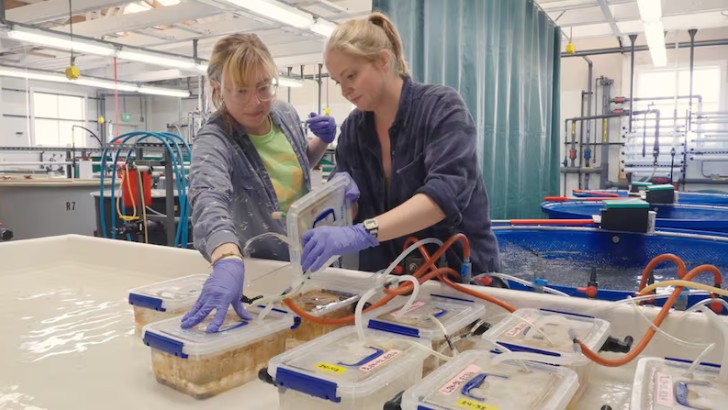
Another particular challenge faced by the research team was that the wasting disease is transmissible in water. During sample collection for experimentation, they assumed the sea stars could have been exposed to the pathogen at any time. So, researchers had to carefully design a methodology to control potential infection in the collected samples.
“We started with this idea of [thinking] broadly. It could be any pathogen at all. Let's start at the beginning and let's do these really careful experiments to see if we could figure out which one it is, and I think that was a big element of our success,” said Gehman.
The team took healthy sea stars into the lab and exposed them to the infected ones through contaminated water, infected tissue or coelomic fluid (sea star “blood”). The process was repeated over several years to try and isolate the cause.
The disease was successfully transmitted to the healthy stars through the three methods, with more than 90 per cent of healthy sea stars dying within a week of showing symptoms.
“The results completely blew me away. Not at all what we thought was actually going to end up being the causative agent,” said Gehman.
The “why” the epidemic happened remains unknown, but researchers had a couple of plausible explanations. It could be an introduction of the Vibrio species to the coastline around 2013 when the epidemic started.
Alternatively, it would be something that has been around longer, and a change of circumstances like warmer ocean temperaturas could have led to the outbreak.
“Certainly, either of those options is possible, and the great thing now is that we have this understanding of the pathogen, so we can start to collect data to answer that question, and we’re excited to do that in the next couple of years,” said Prentice.
The nosedive in sunflower sea star populations had serious ramifications for the marine ecosystem. Sea stars are a keystone species, an organism that helps define an entire ecosystem; in their absence, the environment would be drastically changed.
They maintain balance in the ecosystem by keeping marine grazers in check.
“Sea stars look innocent, but particularly sunflower stars are actually these voracious predators. They eat all sorts of things on the bottom of the ocean, but they particularly eat urchins,” said Gehman.
The abysmal loss of sunflower sea stars led to an explosion of sea urchin numbers, with the population going up 60 times their usual numbersin some areas. Without a healthy sunflower sea star population to help keep urchins in check, kelp forests are disappearing, harming every specimen that depends on it, including humans.
“We knew they ate urchins; we didn’t know how much [sea stars] mattered until they all died,” said Gehman.
Restoring sea stars to the environment means kelp forests might regrow, improving marine life, sheltering coastlines from storms, and increasing ocean productivity.
“One of the things that we can do now . . . is start to try and recover the species. That involves spawning animals and trying to breed for resistance to this particular pathogen,” said Gehman.
“I definitely think we can do a lot now to help the sea stars that we haven’t been able to do in the past. Now that we know what the pathogen is, we can design tests [to] screen individual animals . . . and screen environmental samples. That will make us more informed in how we’re managing the species as we try to bring it them back to the landscape,” said Prentice.
The Redd Fish Restoration Society encourages anyone to learn more about the wasting syndrome, participate in sea star surveys and volunteer for research. To learn more about the project, please visit.