Each winter coastal Vancouver Island can count on periods of a steady deluge of rain – but as residents wait out the storms, there won’t always be electricity available to heat homes and refrigerate food.
On Sunday, Jan. 11 power was again cut off to the island’s northwest region, affecting the communities of Zeballos, Oclucje and Kyuquot as another atmospheric river washed through coastal B.C. From Sunday to the morning of Tuesday, Jan. 13 up to 200 millimetres was expected to hit the west coast of Vancouver Island, more than anywhere else in the province.
“It was pretty windy last night,” said Kyle Harry on the morning of Jan. 12, who lives in the Ehattesaht village next to Zeballos.
His power went out at 10:20 p.m., according to BC Hydro, affecting over 200 people who live in Zeballos and adjacent First Nation community of Ehatis.
Electricity had only been on for a day before it went out Sunday evening, as the area lost power for three days the week before. Some supplies spoiled when freezers lost electricity.
“There’s about six families here in Zeballos that lost all of their food,” said Harry, adding that power was out of a week in December as well.
Like many in the remote community, Harry’s home is heated by wood, and he relies on a gas-powered generator to supply electricity to critical appliances during the outages that regularly occur each winter. Harry has been using a large 13,500-watt generator, which burns 20 litres of gasoline in 15 hours. In the last week he’s gone through 80 litres to power the home and keep his storage of seafood frozen.
“I just got a whole bunch,” said Harry. “I have one freezer just for all my seafood. But I plug both of my freezers in, and my fridge. Those are the main things I plug in right away.”
“The band has some for people who can’t afford their own,” he noted of the First Nation’s generators that it lends to members. “I bought my own. It lights up my whole house.”
A short drive on a logging road west leads to the tiny village of Oclucje, where less than two dozen Nuchatlaht First Nation members live at the end of the Espinosa Inlet. Oclucje lost power on Sunday as well, but fortunately most residents are prepared with a wood stove, while at least three households have their own generators. The First Nation has another four large generators situated near homes for members to plug into during power outages, said Nuchatlaht’s receptionist Florencia Michael.
“The office supplies fuel for them,” she said. “We have one for the office that keeps our office running and as a warming centre.”
The outage also hit further north in Kyuquot, which lost power about an hour before Zeballos. The coastal community often loses power along with Zeballos, although the 200-some residents living in the Ka:'yu:'k't'h'/Che:k'tles7et'h' village of Houpsitas get their power from a private company that buys electricity from BC Hydro. Kyuquot Power sends electricity from the BC Hydro grid through a single 52-kilometre line that runs over land and under the sea to reach Houpsitas.
“Kyuquot was out before us, I was getting messages from relatives out there,” said Harry.
As of 4 p.m. Monday the power to Zeballos and Oclucje was still out, an incident that “requires a specialized crew and equipment. It’s in their queue and they’ll be on their way as soon as they can,” states BC Hydro.
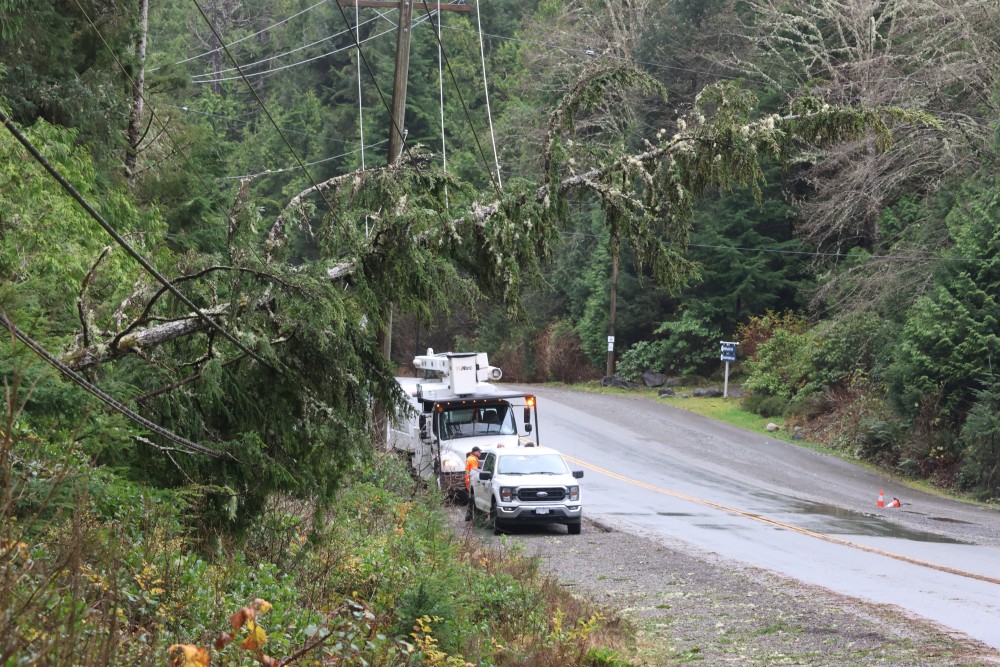
Spokesperson Ted Olynyk says the previous week’s outage was likely caused by a tree falling on a power line, but details about the recent incident were not available. An aerial survey of the power line wasn’t possible during the heavy rain.
“We have to fly it to do a complete patrol, and they can’t do that today,” said Olynyk on the morning of Jan. 12. “The rain is still heavy right now.”
Falling vegetation is the leading cause of power outages on the coast, and BC Hydro manages a four-year cycle of monitoring the state of trees near power lines to remove anything that appears hazardous and at risk of falling on a utility line during a storm.
“We have more trees per kilometre of utility line on Vancouver Island than any place else in North America,” said Olynyk. “We do a lot of trimming, but we don’t go as far as the biggest tree.”
Despite BC Hydro’s increased investment in recent years to mitigate danger trees, outages will be inevitable in coastal settlements, said Olynyk. The provincial utility encourages people to always be prepared with a plan and emergency kit.
“We’ll do our best to try and get everything, but we live on the edge of the Pacific,” said Olynyk of the vegetation mitigation work. “You’re going to get outages wherever you live on the island - it’s just a question of when, for how long.”
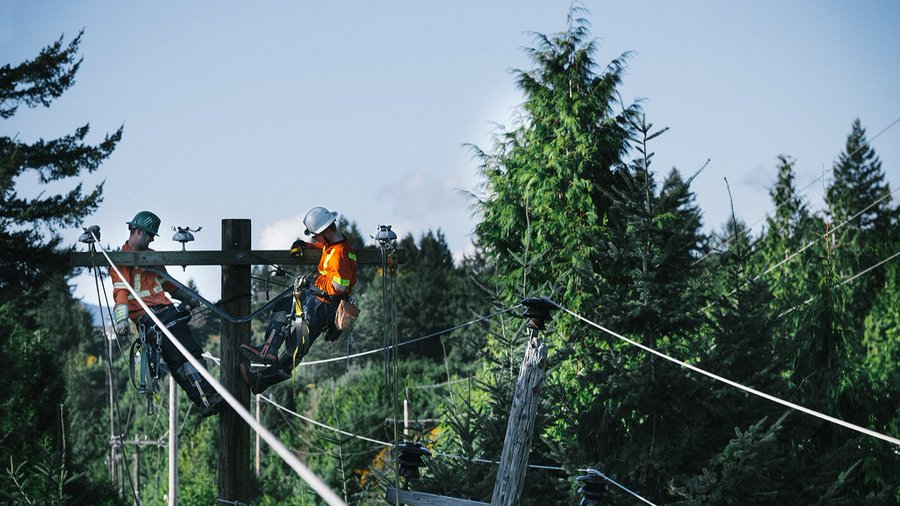
Even when the location of an outage is found, Vancouver Island’s coastal terrain can make it difficult for a crew to access the spot. At times BC Hydro personnel use an ATV, then hike in with snowshoes.
“It’s one of the most challenging places in the province for a line when we put it through many, many years ago,” said Olynyk. “It can be a real challenge to get into some areas. In the past the helicopter would winch [personnel] down to get to some areas.”