The University of Victoria will receive funding to advance ocean research of black holes, deep sea life, and oncoming earthquakes off the west coast of Vancouver Island.
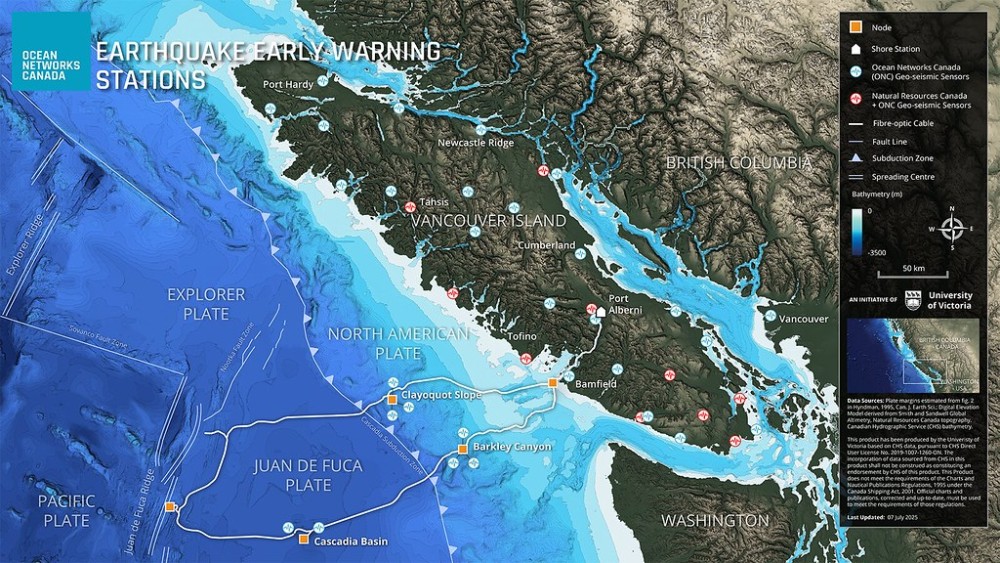
The federal government’s Canada Foundation for Innovation announced in March $1.65 million in funding to upgrade a multi-disciplinary ocean observatory, the NEPTUNE (North-East Pacific Time-series Undersea Networked Experiments) research facility in Barkley Sound.
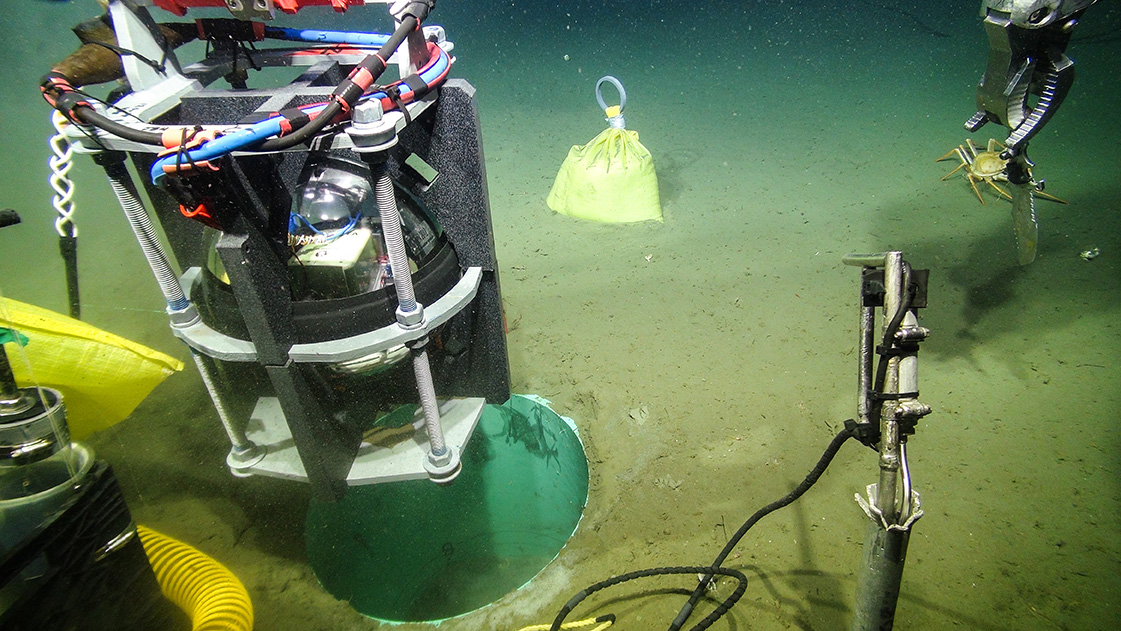
The enhancements will be used for new deep-sea power and communication nodes on the observatory, which will support breakthrough research in oceanography, marine biology, seismology, acoustics, and particle physics.
Ocean Networks Canada (ONC) is a non-profit initiative of the University of Victoria that develops and manages the world’s most advanced cabled ocean observatories. NEPTUNE was first established by ONC in 2009 and was the world's first regional-scale underwater ocean observatory that plugs directly into the Internet and provides power to sensors.
With a network of oceanographic instruments installed on the sea floor that record data from hundreds of sensors, NEPTUNE - the largest ONC installation in Canada - is linked to shore via shielded cables carrying power and fibre-optic communication lines, allowing scientists to transmit continuous, real-time data of ocean-floor conditions to universities and researchers around the world.
With a total cable length of over 800 kilometres, the NEPTUNE network runs through Barkley Sound from Port Alberni all the way to 300 kilometres offshore, before looping back to Port Alberni. It is the only large ocean observatory on the west coast of Vancouver Island.
“The origin of NEPTUNE was in Huu-ay-aht First Nations territory,” said Dr. Sean Rogers, executive director of the Bamfield Marine Sciences Centre (BMSC). “It was born out of the idea that understanding ocean weather is important. We can’t be down at the bottom of the ocean all the time, but with what ONC has accomplished, they can. It’s such critical infrastructure for Canada. Working under the sea is difficult and expensive, so it’s really important that we continue to invest in this space.”
Benoît Pirenne, a corporate innovation and technology officer at ONC, has been with the NEPTUNE project since 2004.
“Technology evolves fast, and with more users wanting their instruments on our observatories, that demands more capabilities,” Pirenne explained.
Named Unlocking New Knowledge of the Ocean with NEPTUNE, the node upgrades project is essentially “a technology refresh to provide extra data bandwidth and power capacity,” said Pirenne.
The upgrades will support more of the research NEPTUNE has already been undertaking, including seismometers to monitor earthquakes, sensors to measure long-term changes in currents and temperature as the earth warms up, hydrophones to listen to whales, and instruments that record changes in the ocean’s salinity and oxygen levels.
“Ensuring a long-time series is important,” said Pirenne. “These new nodes will allow us to continue to collect these details for many years to come.”
NEPTUNE’s upgraded power and data facilities will also enable new research.
“The upgrades to the sensors will be able to measure things that we didn’t even imagine needing to measure 20 years ago,” said Rogers.
“One large project we’re supporting now and in the future is the Pacific Ocean Neutrino Experiment (P-ONE),” said Pirenne. “This involves very sensitive light detectors, which are used to time the arrival of any blip of light near the ocean bottom.”
This data will then be used by astronomers and astrophysicists to better understand the cosmos and the nature of black holes, supernova outbursts, and other cosmic particle accelerator events.
As Pirenne explains, “these new light measuring instruments will also be useful for marine biologists studying bioluminescence, who have discovered that more and more deep-ocean creatures use light to communicate.”
The coming upgrades will include new instruments to improve earthquake monitoring.
“One of the sites on the NEPTUNE system is at the junction of three tectonic plates,” said Pirenne. “The data collected there won’t necessarily improve earthquake alerts, but it will help scientists’ understanding of how and why earthquakes here occur, and could eventually support earthquake information messaging systems that help alert industry and critical infrastructure operators about oncoming earthquakes.”
“It will really give us an opportunity to learn more about ocean weather,” Rogers added. “In terrestrial weather we now have incredible predictions down to the hour. And yet we’re still very poor at predicting ocean weather. Those predictions make a big difference for things like food security and salmon runs. It’s all connected, as the Huu-ay-aht say, Hišuk ma c̕awaak.”
This new earthquake research will also inform tsunami science. But when asked about deep-sea mining, Pirenne says that “the west coast of the Island where we are operating is a Marine Protected Area, so nothing of that sort could happen there.”
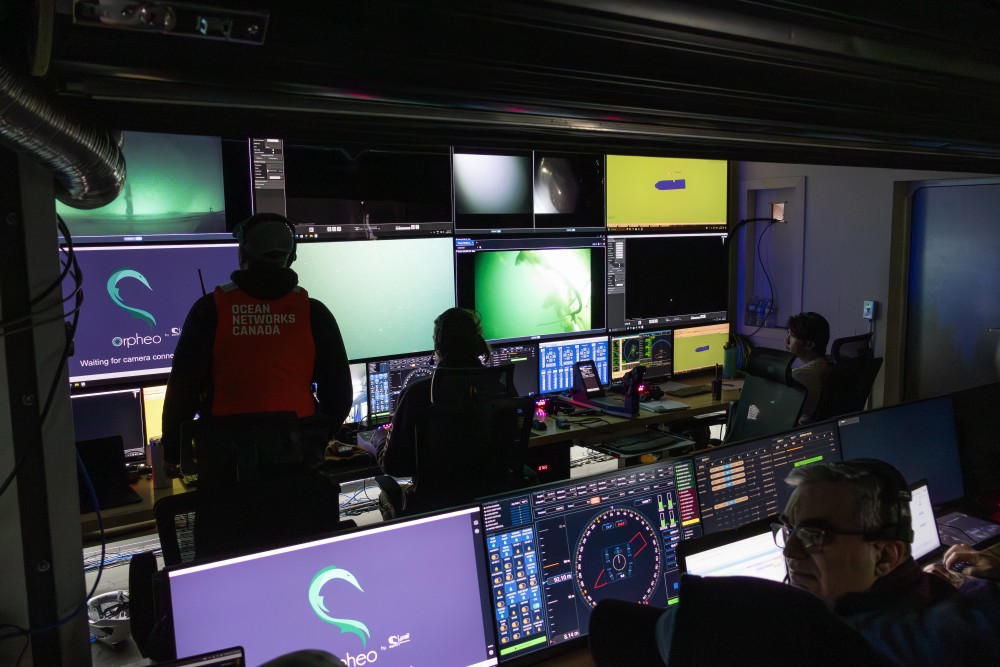
The new upgraded nodes for NEPTUNE will be built in-house at the University of Victoria, where the ONC team will assemble and test the new equipment. With some of NEPTUNE’s nodes located at a depth of over two and a half kilometres, the ONC team will install the new equipment on the ocean floor via remotely operated robots from a vessel on the water’s surface. Like all ONC’s regular expeditions, the installation will be available to watch live online.
Rogers praises ONC’s videos from NEPTUNE’s sensors, which are available to watch on their website.
“ONC has done an amazing job of curating all that data, so anyone anywhere can go online and be a scientist.”
Rogers also teased a new ONC community observatory that his team has recently secured funding for, which will be installed underwater next to the Bamfield Marine Sciences Centre within the next nine months.
“It’s going to be a game changer. It will bring together all our work with Huu-ay-aht First Nations and connect it all over the world,” said Rogers. “We’ll be continuing to invite community to see what’s underwater in the ḥaḥuułi. That’s where these upgrades are important to connect with the community, in terms of the difference that it can make in their lives.”
The first of the new NEPTUNE upgraded nodes is planned to be deployed in 2028.
To watch ONC’s regular NEPTUNE expeditions live online, visit https://www.oceannetworks.ca. ONC’s next expedition is scheduled to begin on July 27, 2026.